
Glue Ear Treatment in Children
Table of Contents
English (Comprehensive Medical Guide)
Glue Ear in Children: A Parent’s Complete Guide to Diagnosis, Speech Risks, and Treatment
Introduction: The “Silent” Hearing Thief
Does your child often say “What?” when you speak to them? Do they turn the TV volume up to levels that are uncomfortable for everyone else? Or perhaps their teacher has complained that they are “daydreaming” in class. These are not behavioral issues; they are the classic signs of Glue Ear, medically known as Otitis Media with Effusion (OME). Glue Ear Treatment in Children
At PRIME ENT Center Hardoi, Dr. Prateek Porwal and Dr Harshita Singh sees hundreds of children every year who are mislabeled as “inattentive” or “naughty” when, in reality, they simply cannot hear clearly. Glue Ear is the leading cause of preventable hearing loss in childhood. This comprehensive guide will explain exactly what is happening inside your child’s ear and how we can fix it.
What Exactly is Glue Ear?
To understand Glue Ear, we first need to understand how a healthy ear works.
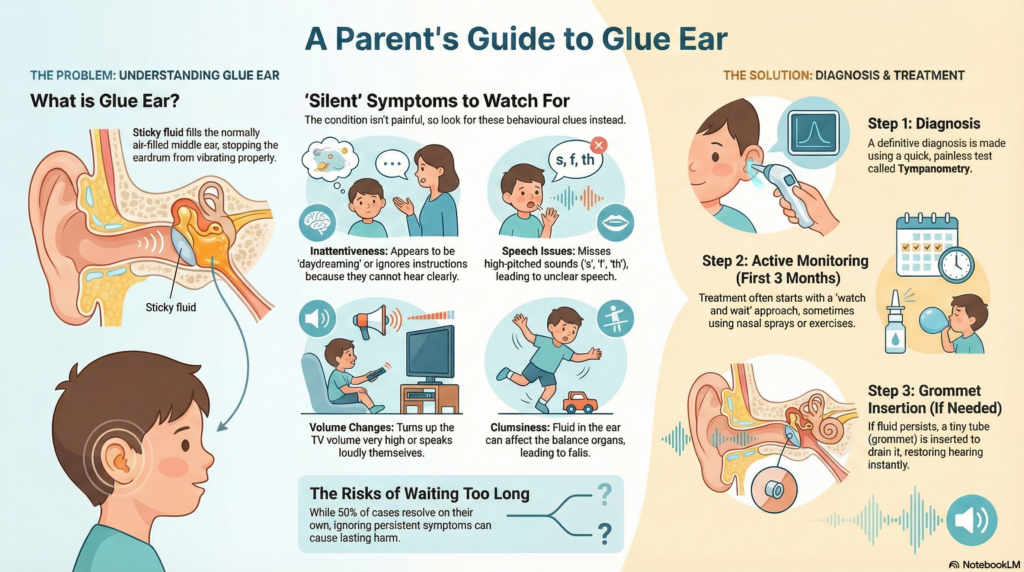
- The Healthy Ear: The middle ear (the space behind the eardrum) is normally filled with air. This air allows the eardrum to vibrate freely when sound hits it, transmitting clear signals to the brain. This air is refreshed by the Eustachian Tube, a small pipe connecting the ear to the back of the nose.
- The Glue Ear: In children, the Eustachian tube is immature—it is shorter, narrower, and more horizontal than in adults. When a child gets a cold, allergy, or has enlarged Adenoids, this tube gets blocked. The air inside the middle ear gets absorbed, creating a vacuum that sucks fluid out of the lining. Over weeks, this thin fluid turns into a thick, sticky substance resembling glue.
- The Result: Imagine trying to beat a drum that is filled with water. It won’t make a sound. Similarly, a fluid-filled ear cannot vibrate, causing Conductive Hearing Loss.
Why Does This Happen? (The Causes)
Glue Ear is rarely caused by a single factor. It is usually a “perfect storm” of conditions:
- Enlarged Adenoids: These are tonsil-like glands at the back of the nose. When they swell, they physically block the Eustachian tube opening. Glue Ear Treatment in Children
- Frequent Colds & Flu: Viruses like RSV cause inflammation that shuts down the ear’s drainage system.
- Allergies: Allergic Rhinitis causes swelling in the nasal passages, leading to chronic blockage.
- Anatomy: Children with Cleft Palate or Down Syndrome have poorer muscle function in the Eustachian tube, making them highly prone to OME.
- Bottle Feeding: Feeding a baby while they are lying flat on their back can allow milk to flow backward into the ear tube, causing inflammation.
The Hidden Dangers: Why You Cannot Ignore It
Many parents ask, “Will it go away on its own?” The answer is: sometimes, but waiting too long comes with serious risks.
- Speech and Language Delay: The critical window for learning language is ages 1 to 4. If a child hears sounds as “muffled” during this time, they miss the subtle differences between sounds like ‘s’, ‘f’, and ‘th’. This leads to unclear speech that requires speech therapy later.
- Academic Struggles: A child who cannot hear the teacher will drift off, lose focus, and fall behind in reading and phonics.
- Permanent Ear Damage: If the fluid sits for years, it can suck the eardrum inwards (Retraction Pocket), leading to bone erosion or a dangerous cyst called Cholesteatoma.
Recognizing the Symptoms (It’s Not Painful!)
Unlike an acute ear infection, Glue Ear is not painful. You must look for behavioral cues:
- Selective Hearing: Parents often say, “He hears what he wants to hear.” In reality, the child hears low-pitched sounds (like a truck) but misses high-pitched sounds (like speech).
- Loud Voice: The child speaks loudly because they hear their own voice as muffled (Autophony).
- Balance Issues: The fluid affects the balance organs, making the child clumsy or prone to falling.
- Mouth Breathing/Snoring: Often indicates the underlying Adenoid issue.
How We Diagnose It at PRIME ENT Center
Dr. Harshita Singh uses a multi-step approach to confirm the diagnosis:
- Otoscopy: We look at the eardrum. A healthy drum is shiny and grey. A Glue Ear drum looks dull, amber, or yellow, sometimes with visible air bubbles or a fluid line.
- Pneumatic Otoscopy: We puff a tiny bit of air into the ear. A healthy drum moves; a fluid-filled drum stays stiff.
- Tympanometry (Impedance Audiometry): This is the definitive test. It sends a pressure wave into the ear. A “Type B” (Flat) graph confirms fluid.
- Pure Tone Audiometry: For older children, this measures exactly how much hearing has been lost (usually 20–40 decibels).
Treatment Protocol: From Observation to Surgery
We follow strictly international guidelines. We do not rush to surgery.
Phase 1: Active Monitoring (The First 3 Months)
Since 50% of cases resolve spontaneously, we adopt a “Watch and Wait” approach for 3 months.
- Otovent Balloon: We teach the child to blow up a special balloon with their nose. This forces the Eustachian tube open (Autoinflation).
- Nasal Sprays: If allergies are present, steroid sprays may help reduce swelling.
- Antibiotics: These are generally NOT effective for Glue Ear and are avoided unless there is an active infection.
Phase 2: Surgical Intervention (When to Act)
If the fluid persists beyond 3 months OR if there is significant hearing loss (>25dB) affecting speech/school, surgery is the gold standard.
The Procedure: Myringotomy with Grommet Insertion
- What it is: A microscopic surgery done under short anesthesia (mask anesthesia).
- The Steps:
- Dr. Prateek makes a tiny incision (hairline cut) in the eardrum.
- The thick “glue” fluid is suctioned out.
- A Grommet (a tiny Teflon spool, size of a match head) is placed in the hole.
- How it works: The Grommet acts as an artificial Eustachian tube, allowing air to enter the middle ear.
- The Result: The pain is gone, and hearing is restored immediately in the recovery room.
What About Adenoids?
If the child also has snoring or mouth breathing, we often perform an Adenoidectomy (removing the adenoids) in the same sitting. Studies show this reduces the chance of the fluid coming back by 50%. Glue Ear Treatment in Children
Post-Surgery Care & FAQs
- Q: Will the Grommet stay forever?
- No. As the eardrum heals, it naturally pushes the Grommet out into the ear canal. this usually happens after 6–12 months. Glue Ear Treatment in Children
- Q: Can my child swim?
- Yes, but we recommend earplugs for diving or soapy water (bath time) to prevent dirty water from entering the tube.
- Q: Is the surgery risky?
- It is one of the safest surgeries in medicine. The risk of permanent damage is extremely low (<1%), while the risk of not treating (permanent hearing loss) is much higher.
Hinglish
Bachon Mein Glue Ear: Kya Aapke Bache Ko Sunai Kam De Raha Hai?
Kya aapne kabhi notice kiya hai ki aapka bacha TV dekhte waqt volume bahut tez karta hai? Ya jab aap use peeche se awaaz dete hain toh woh sunta nahi? Kai parents sochte hain ki bacha “natak” kar raha hai ya “dhyaan nahi de raha”. Lekin PRIME ENT Center Hardoi mein Dr. Prateek Porwal batate hain ki ye ek serious bimari ho sakti hai jise Glue Ear kehte hain. Is article mein hum samjhenge ki ye kyun hota hai aur iska ilaaj kaise karein. Glue Ear Treatment in Children
Glue Ear Kya Hota Hai? (Asaan Bhasha Mein)
Humare kaan ke parde ke peeche ek khaali jagah hoti hai jisme hawa (air) honi chahiye. Ye hawa naak ke peeche se ek nali (Eustachian Tube) ke zariye aati hai.
- Problem: Bachon mein ye nali aksar band ho jati hai (sardi, zukam, ya adenoids ki wajah se).
- Natija: Jab hawa nahi aa pati, toh kaan ke andar ki skin paani chhodne lagti hai. Shuru mein ye paani patla hota hai, lekin agar ilaaj na ho, toh ye gond (glue) jaisa gada aur chipchipa ho jata hai.
- Asar: Sochiye agar dholak ke andar paani bhar diya jaye, toh kya wo bajega? Nahi. Waise hi, jab kaan mein paani bhar jata hai, toh parda hil nahi pata aur bache ko sunai dena band ho jata hai. Glue Ear Treatment in Children
Ye Bimari Kyun Hoti Hai?
Iske peeche kayi karan ho sakte hain:
- Adenoids (Naak ke peeche ka maans): Jab ye badh jate hain, toh ye kaan ki nali ko block kar dete hain.
- Bar-bar Zukam (Frequent Cold): Agar bache ko har mahine sardi rehti hai, toh kaan kabhi sookh nahi pata.
- Bottle Feeding: Agar aap bache ko lita kar doodh pilate hain, toh doodh kaan ki nali mein ja sakta hai aur infection kar sakta hai.
Kaise Pehchanein? (Ghar Par Test Karein)
Glue Ear mein kaan dard nahi karta. Isliye ye “Silent Killer” hai. In lakshano par dhyaan dein:
- TV Volume: Bacha TV ke bilkul paas jakar baithta hai.
- Bolne mein dikat: Agar 3-4 saal ka bacha saaf nahi bolta (tutlaata hai), toh ho sakta hai use shabdon ki awaaz saaf sunai nahi de rahi.
- Zor se bolna: Bacha khud chillakar baat karta hai kyunki use apni awaaz dheemi lagti hai.
- School mein shikayat: Teacher kehti hai ki bacha khoya-khoya rehta hai.
Iska Ilaaj Kya Hai? (PRIME ENT Center Ka Tareeka)
Dr. Harshita Singh batati hain ki har bache ko operation ki zaroorat nahi hoti.
Step 1: Wait and Watch (Pehle 3 Mahine)
Hum 3 mahine tak intezaar karte hain kyunki 50% bacho mein ye apne aap theek ho jata hai.
- Hum Otovent Balloon (naak se gubbara phulana) ki exercise karate hain.
- Agar allergy hai toh naak mein dalne wali spray dete hain.
Step 2: Grommet Surgery (Agar Paani Na Sookhe)
Agar 3 mahine baad bhi bache ko sunai nahi de raha, toh hum Microscopic Surgery karte hain.
- Grommet Kya Hai? Ye ek chhota sa plastic ka button hota hai (raayi ke daane jitna).
- Procedure: Kaan ke parde mein ek chhota sa chhed karke sara ‘Glue’ nikal diya jata hai aur wahan ye Grommet laga diya jata hai.
- Faayda: Grommet lagte hi bache ko turant sunai dene lagta hai. Bacha usi din ghar ja sakta hai aur agle din school bhi.
Parents Ke Sawal (FAQs)
- Q: Kya Grommet nikalwana padta hai?
- Nahi. 6 se 12 mahine mein jab kaan theek ho jata hai, toh parda apne aap Grommet ko bahar phenk deta hai. Glue Ear Treatment in Children
- Q: Kya ye operation dangerous hai?
- Bilkul nahi. Ye duniya ke sabse safe operations mein se ek hai. Isse bache ki sunne aur bolne ki kshamta bachayi jati hai.
- Q: Kya bacha naha sakta hai?
- Haan, bas dhyan rakhein ki kaan mein sabun ka ganda paani na jaye. Hum swimming ke liye earplugs suggest karte hain.
Hindi – बच्चों में Glue Ear (कान में पानी भरना): कारण, लक्षण और इलाज की पूरी जानकारी
क्या आपका बच्चा आपकी बात अनसुनी करता है? क्या उसे बार-बार जुकाम रहता है और वह मुँह खोलकर साँस लेता है? यह केवल आदत नहीं, बल्कि कान की एक गंभीर बीमारी Glue Ear (Otitis Media with Effusion) हो सकती है। PRIME ENT Center Hardoi में हम माता-पिता को जागरूक करना चाहते हैं कि अगर समय पर इलाज न हो, तो यह बीमारी बच्चे को हमेशा के लिए बहरा बना सकती है।
Glue Ear क्या है?
सामान्य कान में परदे के पीछे हवा होती है। लेकिन बच्चों में, कान और नाक को जोड़ने वाली नली (Eustachian Tube) कमजोर होती है। जब बच्चे को सर्दी या एलर्जी होती है, तो यह नली बंद हो जाती है। नतीजा यह होता है कि कान के अंदर हवा की जगह गाढ़ा, गोंद जैसा चिपचिपा पानी भर जाता है। इसे ही Glue Ear कहते हैं।
इसके लक्षण (Symptoms) क्या हैं?
सबसे बड़ी समस्या यह है कि इसमें बच्चे को कान में दर्द नहीं होता। इसलिए माता-पिता इसे पहचान नहीं पाते।
- ऊँचा सुनना (Hearing Loss): बच्चा धीमी आवाज नहीं सुन पाता।
- बोलने में देरी (Speech Delay): अगर बच्चा “स”, “फ”, “थ” जैसे शब्दों को साफ नहीं बोल पाता, तो इसका कारण यह हो सकता है कि उसे ये शब्द सुनाई ही नहीं देते।
- चिड़चिड़ापन: अपनी बात न समझा पाने के कारण बच्चा जिद्दी हो जाता है।
- संतुलन बिगड़ना: बच्चा चलते-चलते गिर सकता है क्योंकि कान का पानी बैलेंस खराब करता है।
डॉक्टर कैसे जाँच करते हैं?
Dr. Prateek Porwal कान की आधुनिक मशीनों से जाँच करते हैं:
- Otoscopy: दूरबीन से देखने पर कान का परदा पीला या धुंधला दिखाई देता है।
- Tympanometry: यह सबसे मुख्य टेस्ट है। इसमें कान के अंदर का दबाव नापा जाता है। अगर Type B Graph आता है, तो इसका मतलब है कि कान में पानी भरा है।
इलाज (Treatment)
हमारा उद्देश्य है – पानी निकालना और सुनने की शक्ति वापस लाना।
1. दवाइयां और कसरत (Medical Management)
शुरुआत में हम सर्जरी नहीं करते। हम बच्चे को Valsalva (नाक बंद करके कान में हवा भरना) या Otovent Balloon (नाक से गुब्बारा फुलाना) जैसी कसरत सिखाते हैं। इससे कान की नली खुलने में मदद मिलती है। Glue Ear Treatment in Children
2. सर्जरी (Grommet Insertion)
अगर 3 महीने तक पानी नहीं सूखता, तो Dr. Harshita Singh एक छोटा ऑपरेशन (Myringotomy) करने की सलाह देती हैं।
- Grommet क्या है? यह एक बहुत छोटा वेंटिलेशन ट्यूब (Ventilation Tube) है।
- प्रक्रिया: कान के परदे में एक सूक्ष्म छेद करके सारा पानी निकाल दिया जाता है और वहाँ यह ट्यूब लगा दी जाती है। यह ट्यूब कान में हवा का आना-जाना बनाए रखती है।
- Adenoidectomy: अगर बच्चे के नाक के पीछे का मांस (Adenoids) बढ़ा हुआ है, तो उसे भी इसी ऑपरेशन में निकाल दिया जाता है ताकि बीमारी दोबारा न हो। Glue Ear Treatment in Children
निष्कर्ष (Conclusion)
Glue Ear एक “छुपा हुआ दुश्मन” है। यह बच्चे की पढ़ाई, बोलने की क्षमता और आत्मविश्वास को खत्म कर सकता है। अगर आपको जरा भी शक हो, तो आज ही PRIME ENT Center Hardoi में जाँच कराएं। याद रखें, एक छोटा सा इलाज आपके बच्चे के भविष्य को बदल सकता है। Glue Ear Treatment in Children