
Mouth‑Breathing Child: Enlarged Adenoids and Their Effect on Teeth and Growth (Parent Guide) Hardoi
At PRIME ENT Centre Hardoi, Dr Prateek Porwal and Dr Harshita Singh commonly see children whose “habit” of mouth breathing is actually a siMouth breathing child enlarged adenoids: a comprehensive guide for parents.gn of chronic nasal airway blockage—most often from adenoid hypertrophy (enlarged adenoids).
Table of Contents
English
The Hidden Impact of Airway Obstruction
For many children, the act of breathing—which should be silent and effortless through the nose—becomes a noisy, persistent struggle through the mouth. While parents may view chronic mouth breathing as a simple habit, in paediatric otolaryngology it is often the hallmark of upper airway obstruction, most commonly caused by enlarged adenoids.
The adenoids, though invisible without specialised equipment, play a disproportionate role in a child’s early development. When they become pathologically enlarged, they do more than just cause a “blocked nose”; they initiate a cascade of changes that can influence facial growth, dental alignment, sleep, behaviour, and overall physical development.
This guide from PRIME ENT Centre Hardoi helps parents recognise the signs of adenoid hypertrophy and understand why mouth breathing should never be ignored.
1. Understandinin Mouth Breathing Childreng the Adenoids: Anatomy and Function
What and where are the adenoids?
- The adenoids (pharyngeal tonsil of Luschka) are a single midline mass of lymphoid tissue located at the junction of the roof and posterior wall of the nasopharynx.
- They are part of Waldeyer’s ring—a protective circle of lymphoid tissue that also includes the palatine tonsils and lingual tonsils.
- Their job is to help the immune system recognise and respond to inhaled and ingested pathogens during early childhood.
The natural life cycle of adenoids
- Present from birth and often colonised with bacteria early in life.
- Undergo rapid growth during infancy and early childhood.
- Typically reach maximal size between 3 and 7 years of age.
- This peak coincides with increased exposure to infections in nursery and school.
- In many children, adenoids gradually regress around puberty, but in some they remain large and symptomatic.
When do adenoids become “pathological”?
Adenoids are considered problematic when they:
- Obstruct nasal airflow (nasal obstruction, snoring, mouth breathing).
- Contribute to recurrent infections (adenoiditis, sinusitis, ear infections).
- Interfere with Eustachian tube function, leading to middle ear problems.
Importantly, absolute size is less important than the space available:
- A child with a narrow nasopharynx or small maxilla can have severe obstruction with “average-sized” adenoids.
- Another child with more room may remain asymptomatic despite larger tissue.
2. The Transition to Mouth Breathing: Pathophysiology
From nose-breathing to mouth-breathing
- Newborns and young infants are obligate nasal breathers, meaning they rely primarily on the nose for breathing, especially during feeding.
- When the nasal passage is blocked—by enlarged adenoids, choanal atresia, severe allergy or mucosal swelling—the child is forced to adopt an open‑mouth posture just to maintain airflow.
The “vicious cycle” of obstruction
- Nasal obstruction → child opens mouth to breathe.
- Mouth breathing dries and irritates upper airway tissues.
- Stagnant secretions in the nose and nasopharynx encourage infection.
- Infection and inflammation cause further swelling and adenoid enlargement.
- Even after acute infection settles, the habit of mouth breathing may persist.
Over time, the child becomes an obligate mouth breather, even in situations where the airway might have been adequate, simply because nasal breathing no longer feels “natural”.
3. “Adenoid Facies”: Impact on Facial and Dental Growth
One of the most important long‑term consequences of chronic mouth breathing is its effect on the developing craniofacial skeleton.
Functional matrix concept
The functional matrix theory suggests that facial bone growth is strongly influenced by:
- Soft tissues around the bones (muscles, tongue, cheeks).
- The spaces within the head and neck (mouth, pharynx, nasal cavity, sinuses).
When a child keeps the mouth open chronically, the balance of forces exerted by tongue, lips and cheeks is altered. This gradually affects the shape of the jaws and dental arches.
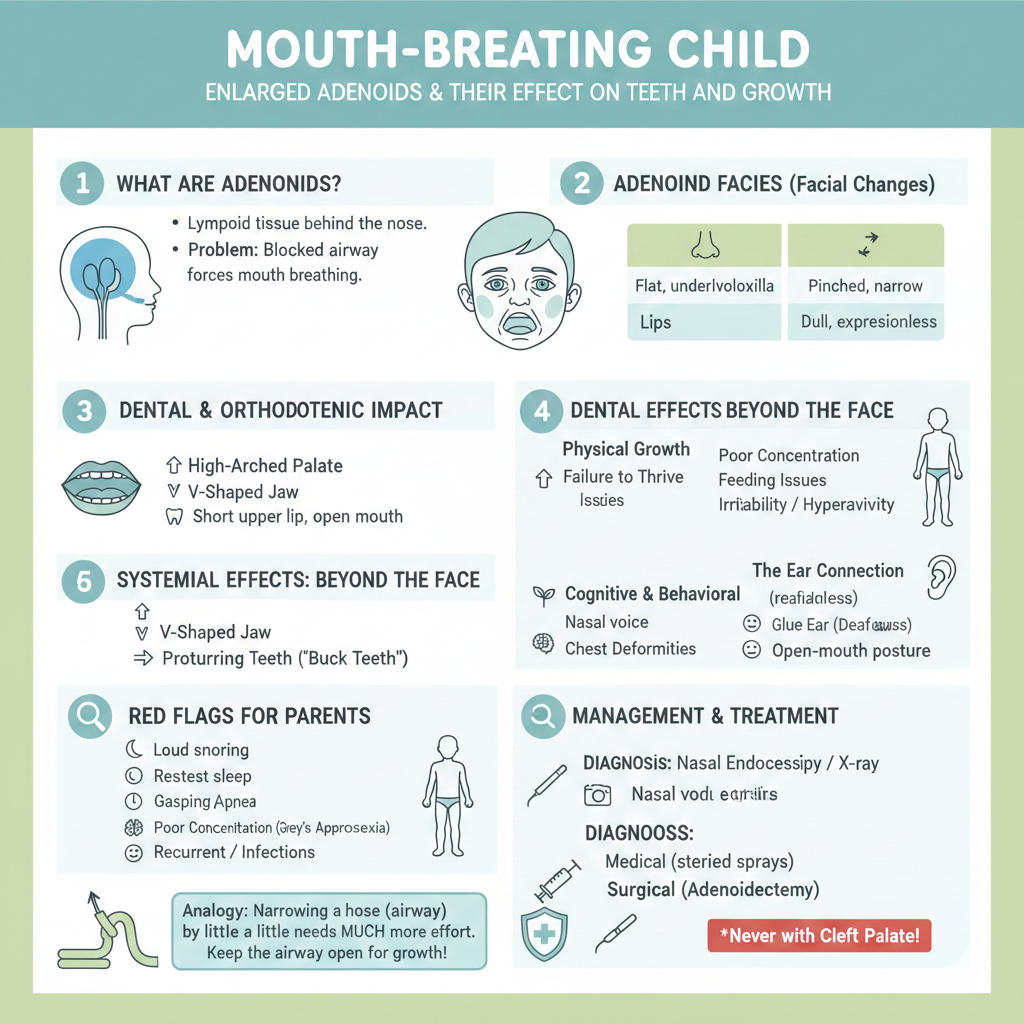
Classic “adenoid facies” – what parents may see
Children with long-standing adenoid hypertrophy and mouth breathing may develop:
- Dull, tired or expressionless facial appearance.
- Narrow, pinched nostrils and underdeveloped nasal wings.
- Short, retracted upper lip with teeth often visible at rest.
- Long, narrow face with a relatively flat mid‑face due to underdeveloped maxilla.
- Habitually open mouth posture.
These changes are gradual and may be overlooked unless someone compares earlier photographs with current appearance.
Effect on teeth and dental occlusion
Under normal conditions:
- The tongue rests against the hard palate, providing outward support to the upper jaw.
- The cheeks and lips exert inward pressure.
- A balance between these forces helps the upper arch grow broad and rounded.
With chronic mouth breathing:
- The mandible drops and the tongue sits low in the mouth to keep the airway open.
- The tongue no longer supports the palate from within.
- Cheeks and lips push inward unopposed.
This leads to:
- Narrow maxillary arch – upper jaw becomes V‑shaped rather than U‑shaped.
- High‑arched palate – the roof of the mouth is pushed upwards.
- Dental crowding – inadequate space for permanent teeth, especially incisors.
- Proclined, protruding upper incisors – commonly called “buck teeth”.
- Malocclusion – crossbite, open bite or deep bite due to distorted jaw relationships.
Early control of airway obstruction and collaboration between ENT and orthodontics can reduce the severity of these changes.
4. Systemic Consequences: Growth, Chest and Brain
Physical development and stunted growth
Chronic upper airway obstruction is recognised as a contributing factor to failure to thrive or poor weight gain. Reasons include:
- Increased work of breathing – breathing against resistance uses extra energy that should support growth.
- Feeding difficulties – mouth‑breathing children often eat slowly, pause frequently to breathe, and may swallow inadequately chewed food.
- Disturbed sleep – poor‑quality sleep can interfere with optimal release of growth‑related hormones.
Over months and years, this can manifest as:
- Lower weight or height percentile compared to peers.
- Reduced stamina and easy fatigability.
Chest and skeletal deformities
Long‑standing airway obstruction with use of accessory muscles of respiration in a growing child can contribute to:
- Pectus deformities (shape changes of the chest wall).
- Harrison’s sulcus – a groove along the lower border of the ribs, associated with chronic laboured breathing.
Although not all mouth‑breathing children will develop these deformities, the combination of respiratory effort and malnutrition in severe cases increases the risk.
Cognitive and intellectual impact
Poor sleep quality, fragmented sleep and reduced oxygenation at night can affect:
- Attention and concentration.
- Memory and learning.
- Behaviour and emotional regulation.
Such children may be perceived as:
- Lethargic, uninterested or “slow”.
- Hyperactive or impulsive (as a way of fighting sleepiness).
- “Back‑benchers” with declining school performance.
Addressing the airway problem can significantly improve alertness, mood and academic potential.
5. Secondary Complications: Ears and Speech
The ear connection – why adenoids matter
The adenoids lie close to the openings of the Eustachian tubes in the nasopharynx. When they are enlarged or infected, they can:
- Mechanically block the Eustachian tube openings.
- Act as a reservoir of bacteria, allowing infection to track into the middle ear.
Common consequences include:
- Otitis Media with Effusion (OME / “Glue Ear”) – sterile or infected fluid in the middle ear causing muffled hearing.
- Recurrent Acute Otitis Media – repeated painful ear infections.
- Tympanic membrane changes – due to long‑term negative middle ear pressure and recurrent inflammation.
Parents may notice:
- Child increasing TV volume.
- Not responding when called.
- Talking loudly or unclearly.
Speech and voice changes
Enlarged adenoids reduce the size of the nasopharyngeal airway and alter resonance. This can cause:
- Hyponasal speech – voice sounds “blocked‑nose” or closed.
- Difficulty with nasal sounds like m, n, ng, which may sound like b, d, g.
- Overall flat, dull voice quality.
In addition, hearing loss from glue ear can cause:
- Mispronunciation of words.
- Delayed speech development.
6. Recognising the Signs: Checklist for Parents
Parents should pay attention if the following symptoms persist for more than a few weeks:
Night‑time symptoms
- Loud, habitual snoring.
- Restless sleep with frequent turning.
- Pauses in breathing (apnoea) followed by gasps or snorts.
- Mouth open throughout sleep.
Day‑time symptoms
- Chronic mouth breathing.
- Persistent blocked nose or “wet, bubbly” nasal discharge.
- Hyponasal (closed‑nose) speech.
- Daytime sleepiness, irritability or headaches.
Physical signs
- Open‑mouth posture at rest.
- Dark circles under the eyes (“allergic shiners”).
- Long, dull‑looking face, narrow nostrils, visible upper teeth.
Behaviour and school performance
- Decline in school performance or concentration.
- Hyperactivity or difficulty sitting still.
- Bedwetting (nocturnal enuresis) in some children.
If multiple signs are present, especially snoring + mouth breathing + poor school performance, an ENT evaluation is strongly recommended.
7. Diagnosis: How Specialists Evaluate the Airway
At PRIME ENT Centre Hardoi, evaluation by Dr Prateek Porwal or Dr Harshita Singh typically includes:
Clinical history
- Onset and duration of mouth breathing and snoring.
- Sleep pattern, witnessed apnoea or restless sleep.
- Frequency of colds, sinus issues, antibiotic courses.
- Ear problems, hearing concerns and speech development.
- Growth, appetite and school performance.
Physical examination
- Facial profile and “adenoid facies” features.
- Nasal examination for septal deviation, turbinate hypertrophy or polyps.
- Oral cavity and oropharynx (tonsils, palate, tongue size).
- Ear examination and basic hearing screening.
Diagnostic tools
- Nasal endoscopy: a thin telescope (rigid or flexible) passed gently through the nose to visualise adenoids and Eustachian tube openings.
- Lateral nasopharyngeal X‑ray: can show size of adenoid mass and remaining airway in selected cases.
- Polysomnography (sleep study): considered when obstructive sleep apnoea is strongly suspected or when symptoms are severe.
The aim is to confirm whether enlarged adenoids are the primary cause of obstruction and to assess associated ear and sleep issues.
8. Management: Medical and Surgical Options
Medical management
In mild or borderline cases, or when allergy plays a significant role, conservative treatment may include:
- Saline nasal washes or sprays.
- Treatment of allergic rhinitis (antihistamines, nasal steroid sprays).
- Monitoring of growth, sleep and school performance.
These measures can reduce mucosal swelling and improve nasal breathing but may not fully reverse obstruction when adenoids are significantly enlarged.
Surgical managemefor Mouth Breathing Child with Enlarged Adenoidsnt: Adenoidectomy
When symptoms are persistent and significantly affect quality of life—especially with:
- Chronic mouth breathing and snoring.
- Suspected or documented obstructive sleep apnoea.
- Recurrent otitis media or persistent glue ear.
- Facial growth and dental changes.
—adenoidectomy (surgical removal of adenoid tissue) is considered.
Key points:
- Performed under general anaesthesia.
- Child is usually positioned supine with neck extended (Rose’s position).
- Adenoid tissue is removed using a curette, suction diathermy, coblation or microdebrider.
- Bleeding is controlled, and the child is observed closely in recovery.
Recovery
- Mild throat or referred ear pain for a few days is common.
- Soft, cool diet and good hydration are advised.
- Most children resume normal activity within a week.
Absolute and relative contraindications
Adenoidectomy is avoided or modified in children with:
- Overt cleft palate.
- Submucous cleft palate (often suggested by bifid uvula or a notch in the posterior palate).
In these conditions, adenoids contribute to closure of the nasopharynx during speech and swallowing. Removing them completely can lead to velopharyngeal insufficiency (VPI), causing:
- Hypernasal speech.
- Regurgitation of fluids into the nose.
In such children, special techniques (e.g., partial/superior adenoidectomy) or alternative strategies may be considered after detailed assessment.
Conclusion: The “Garden Hose” Analogy
Think of the child’s airway as a garden hose. Poiseuille’s law tells us that flow through a tube depends heavily on its radius; even a small decrease in diameter can cause a large increase in resistance.
If someone steps on the hose:
- The pump (heart and lungs) must work much harder.
- Very little water (air) comes out for a lot of effort.
Similarly, enlarged adenoids may narrow the airway by just a few millimetres, but the impact on breathing effort, sleep quality, growth and brain function can be dramatic.
By recognising mouth breathing early and addressing enlarged adenoids appropriately, parents can ensure that this “hose” remains open—allowing their child to invest energy in growing, learning and thriving, rather than simply struggling to breathe.
If you notice chronic mouth breathing, loud snoring or recurrent ear problems in your child, book a consultation at PRIME ENT Centre Hardoi with Dr Prateek Porwal or Dr Harshita Singh for a comprehensive airway and growth assessment.
Hinglish
Introduction: Mouth Breathing – Sirf Aadत Nahin, Airway Blockage Ka Sign
Bachchon mein breathing ideally naak se silent aur aaram se honi chahiye. Lekin jab bachcha raat‑din munh khol kar saans leta hai, parents aksar ise “aadat” samajh ke ignore kar dete hain. ENT point of view se yeh aadat aksar upper airway obstruction, sabse zyada enlarged adenoids, ka sign hoti hai.
Adenoids chhote se lymphoid tissues hote hain jo naak ke peeche छिपे रहते हैं, lekin unka effect poore chehre, daanton, growth aur child ke behaviour tak pahunch sakta hai. Jab yeh zyada bade ho jaate hain, sirf “नाक बंद” nahi karte, balki:
- Face ka structure badal sakte hain,
- Daanton ki lining bigaad sakte hain,
- Growth aur school performance par bhi असर daal sakte hain.
Is guide mein PRIME ENT Centre Hardoi ke perspective se parents ko simple language mein samjhaya gaya hai ki mouth breathing ko lightly kyun nahi lena chahiye.
1. Adenoids kya hote hain?
- Adenoids ek single midline lymphoid tissue ka mass hota hai, jo nasopharynx (naak ke peeche) ke roof aur back wall ke junction par hota hai.
- Ye Waldeyer’s ring ka part hote hain—yaani immune defence ka chakkar jisme tonsils etc. bhi aate hain.
Natural life cycle
- Birth se present rehte hain.
- Early childhood (3–7 saal) mein size peak par hota hai.
- School jaane ke time frequent infections ki wajah se yeh aur reactive ho sakte hain.
- Bohot bachchon mein puberty ke baad dheere‑dheere shrink ho jaate hain, lekin sab mein nahi.
Kab problem banti hai?
Jab adenoids:
- Naak ka rasta block karne lagen (naak band, snoring, mouth breathing),
- Recurrent infection ka source ban jaayen,
- Eustachian tube ko affect karke kan ki problem create karein,
tab unhe pathological maana jaata hai.
Important point: sirf “size” nahi, space matter karta hai. Chhota sa adenoid bhi narrow nasopharynx mein zyada blockage de sakta hai.
2. Nose se munh tak: Mouth Breathing ka Cycle
Normal situation mein:
- Bachche natural taur par nose breathers hote hain.
- Feeding aur breathing dono sahi se ho sakein, isliye naak ka khula rehna bohot zaroori hota hai.
Jab naak block ho jaaye—chahe adenoids se, allergy se ya kisi aur wajah se—bachcha survival ke liye munh khol kar saans lena shuru karta hai.
Vicious cycle
- Naak band → mouth breathing.
- Mouth breathing se airway aur dry/irritated hota hai.
- Secretions jama ho kar infection badhate hain.
- Infection se adenoids aur swell ho jaate hain.
- Block aur badhta hai → child aur zyada mouth breathing karega. Dheere‑dheere bachcha habitual mouth breather ban jaata hai—bhale hi kabhi‑kabhi naak relatively theek ho.
3. “Adenoid Facies”: Chehre aur Daanton par Asar
Long‑term mouth breathing ka sabse visible effect face aur jaws par hota hai.
Functional matrix concept, simple words mein
Face ki haddiyan akela decide nahi kartin ki shape kya hogi; unke around ki soft tissues (tongue, lips, cheeks) aur andar ki spaces (mouth, sinuses, airway) bhi growth ko guide karte hain.
Jab:
- Munh open rehta hai,
- Tongue neeche baithi rehti hai,
- Lips aur cheeks ka inward pressure zyada ho,
to dhire‑dhire jaw ka shape change ho sakta hai.
Adenoid facies – parents kya dekhte hain?
- Long, narrow face.
- Nostrils patle aur pinched.
- Upper lip short ya retracted, teeth baar‑baar dikhte rehte hain.
- Munh hamesha aadha khula.
- Thaka‑thaka, dull sa expression.
Daanton aur bite par effect
Normal:
- Tongue palate se touch karke upper jaw ko andar se support karti hai.
- Cheeks aur lips bahar se press karte hain.
- Balance se arch broad aur rounded rehti hai.
Mouth breathing mein:
- Mandible neeche chala jaata hai.
- Tongue low position mein rehti hai.
- Palate ko koi support nahi milta → cheeks ka inward pressure dominate karta hai.
Result:
- Narrow, V‑shaped maxillary arch.
- High‑arched palate.
- Crowded incisors (daant ek‑dusre par chadh jaate hain).
- Proclined “buck” teeth.
- Crossbite ya open bite jaisi malocclusion.
Early stage par ENT + orthodontist ki joint approach se damage ko kaafi had tak limit kiya ja sakta hai.
4. Growth, Chest aur Brain par Asar
Physical growth
Chronic airway obstruction wale bachchon mein:
- Saans lene mein extra energy lagti hai.
- Khana khane ke dauran baar‑baar saans lene ke liye rukna padta hai.
- Neend toot‑toot kar aati hai.
Is combination se:
- Weight gain slow ho sakta hai.
- Height percentile bhi peers se peeche reh sakta hai.
Chest deformities
Long‑term laboured breathing se kuch bachchon mein:
- Chest ka shape alter ho sakta hai.
- Lower ribs par Harrison’s sulcus jaisi groove develop ho sakti hai.
Yeh sab severe/long‑standing cases mein zyada common hota hai, lekin early airway management se risk kam ho sakta hai.
Behaviour, attention aur school
Poor quality sleep + intermittent oxygen dips se:
- Subah bachcha fresh feel nahi karta.
- Din bhar irritability, mood swings ya hyperactivity aa sakti hai.
- School performance, memory, attention sab par असर pad sakta hai.
Parents aksar report karte hain ki treatment ke baad child zyada alert, khush aur padhai mein active ho jaata hai.
5. Ear Problems aur Speech Changes
Adenoids aur middle ear
Eustachian tube ke opening ke bilkul paas adenoids hote hain. Jab yeh bade/ infected hote hain, to:
- Tube ka opening mechanically narrow ho sakta hai.
- Infection nasopharynx se middle ear tak spread ho sakta hai.
Consequences:
- Otitis Media with Effusion (“glue ear”) → awaz dhimi sunayi dena.
- Recurrent acute ear infections.
- Eardrum par long‑term pressure changes se structural damage ka risk.
Speech aur voice
- Adenoid hypertrophy se nasopharyngeal space kam ho jaata hai.
- Voice “blocked nose” jaisi (hyponasal) lagti hai.
- /m/, /n/, /ng/ jaise sounds clear nahi aate—kayi baar /b/, /d/, /g/ jaisa sunayi deta hai.
- Agar glue ear bhi ho, to child apni voice clearly sun nahi pata, jisse articulation problems aur badh sakti hain.
6. Parent Checklist – Kab ENT ke Paas Jaana Chahiye?
Ye points ek practical checklist ke tarah use kiye ja sakte hain:
Night-time:
- Daily loud snoring.
- Restless sleep, baar‑baar position change.
- Breathing pauses + gasping.
- Munh khula rakhe sone ki aadat.
Day-time:
- Chronic mouth breathing.
- Lagataar naak band rehna ya watery discharge.
- Closed‑nose (naak band) type voice.
- Din mein zyada neend, gussa, headache.
Physical/behaviour:
- Dark circles under eyes.
- Long, dull facial expression.
- School performance down, teacher complaints about attention.
- Bedwetting in an otherwise toilet-trained child.
Agar inmein se multiple points tick ho rahe hain, to delay ki jagah ENT evaluation best hai.
7. Diagnosis at PRIME ENT Centre Hardoi
Dr Prateek Porwal aur Dr Harshita Singh evaluation ko 4 angles se dekhte hain:
- Airway (nose + adenoids)
- Sleep
- Ears and hearing
- Growth and behaviour
History
- Mouth breathing kab se hai?
- Snoring daily hai ya sirf cold ke time?
- Koi witnessed apnoea/ gasping episodes?
- Kitne ear infections hue, kitni baar antibiotics lage?
- Speech delay ya teacher ki complaints?
Examination
- Face ka pattern (adenoid facies features).
- Nose mein septum deviation, turbinates, polyps ka assessment.
- Throat, tonsils, palate, tongue size.
- Ear drum aur basic hearing check.
Investigations
- Nasal endoscopy for direct visualisation of adenoids.
- Lateral X‑ray of nasopharynx in selected cases.
- Sleep study (polysomnography) jab OSA suspicion strong ho.
8. Treatment Plan: Medical vs Surgery
Conservative/medical approach
- Saline nasal irrigation.
- Allergy control (antihistamines, nasal steroid sprays) where indicated.
- Lifestyle advice (avoid smoke exposure, treat reflux etc. if present).
Ye sab mild cases ya intermittent symptoms mein use kiye jaate hain.
Adenoidectomy – kab sochna chahiye?
Indications generally include:
- Persistent nasal obstruction + mouth breathing.
- Loud snoring, suspected OSA.
- Recurrent otitis media / persistent glue ear.
- Facial/dental changes suggesting chronic mouth breathing.
Surgery basics:
- General anaesthesia.
- Mouth se approach; adenoids ko curette, suction diathermy, coblation ya microdebrider se remove kiya jaata hai.
- Usually same‑day or short stay admission.
Recovery:
- 3–7 din tak halka sore throat / referred ear pain.
- Soft, thanda khana and good hydration advised.
- School usually 1 week mein resume ho sakta hai.
Special caution – cleft palate / submucous cleft
Agar child mein:
- Cleft palate,
- Submucous cleft palate (bifid uvula, palate mein notch),
jaise features hain, to adenoidectomy se pehle detailed assessment bohot zaroori hai. In cases mein full adenoid removal se velopharyngeal insufficiency (VPI) aur hypernasal speech ka risk hota hai, isliye surgery ka plan customised hota hai.
Poiseuille’s Law aur “Pipe” Waali Soch
Imagine bachche ka airway ek pipe jaisa hai. Agar radius thoda sa bhi kam ho jaaye, andar se resistance bohot zyada badh jaati hai. Matlab chhota sa blockage bhi body ke liye bohot bada load ban sakta hai.
Agar pipe pe koi pair rakh de to:
- Pump ko (heart + lungs) double/triple mehnat karni padti hai.
- Output kam, effort zyada.
Enlarged adenoids bilkul aise hi kaam kar sakte hain. Isliye chronic mouth breathing, loud snoring aur ear issues ko “wo to aadat hai” bolkar ignore nahi karna chahiye.
Best step: early ENT consult, timely treatment, aur growth years ko protect karna.
At PRIME ENT Centre Hardoi, teams ka focus sirf adenoids hata dena nahi, balki child ki breathing, sleep, ears, teeth aur school performance sab ko saath mein dekh kar holistic plan banana hai.
हिंदी
परिचय: मुँह से साँस लेना – सिर्फ़ आदत नहीं, चेतावनी भी हो सकती है
आदर्श स्थिति में बच्चा नाक से शांत और आराम से साँस लेता है। जब वह हर समय मुँह खोले रखकर साँस लेने लगे, तो कई बार माता‑पिता इसे केवल “आदत” मान कर नज़रअंदाज़ कर देते हैं। ENT की दृष्टि से यह अक्सर ऊपरी श्वास नली में रुकावट (upper airway obstruction) का संकेत होता है, जिसका सबसे आम कारण बढ़े हुए एडेनॉइड्स हैं।
एडेनॉइड्स छोटे, लेकिन प्रभावशाली ऊतक हैं जो नाक के पीछे छिपे रहते हैं। इनके बढ़ जाने पर केवल “नाक बंद” नहीं होती, बल्कि:
- चेहरे और जबड़े के विकास में बदलाव,
- दाँतों की पंक्ति में गड़बड़ी,
- नींद, व्यवहार और पढ़ाई पर भी असर पड़ सकता है।
यह लेख PRIME ENT Centre Hardoi की ओर से माता‑पिता के लिए तैयार किया गया है, ताकि वे मुँह से साँस लेने को समय रहते पहचान कर सही कदम उठा सकें।
1. एडेनॉइड्स – संरचना और कार्य
- एडेनॉइड्स एक एकल मध्य रेखीय लिम्फॉइड ऊतक का द्रव्यमान हैं, जो नासोफैरिंक्स की छत और पिछले भाग के जंक्शन पर स्थित होता है।
- ये Waldeyer’s ring का हिस्सा हैं—एक सुरक्षात्मक लिम्फॉइड रिंग जिसमें टॉन्सिल आदि भी शामिल होते हैं।
प्राकृतिक जीवन चक्र
- जन्म से उपस्थित रहते हैं।
- 3–7 वर्ष की आयु में सामान्यतः सबसे बड़े आकार में पहुँचते हैं।
- इस समय बच्चे प्री‑स्कूल और स्कूल में नये‑नये संक्रमणों के संपर्क में आते हैं, जिससे एडेनॉइड्स अधिक सक्रिय हो जाते हैं।
- कई बच्चों में किशोरावस्था के बाद ये धीरे‑धीरे सिकुड़ने लगते हैं, पर सभी में नहीं।
कब समस्या बनते हैं?
एडेनॉइड्स को “समस्याग्रस्त” तब माना जाता है जब वे:
- नाक से साँस लेने में रुकावट पैदा करें (नाक बंद, खर्राटे, मुँह से साँस लेना),
- बार‑बार संक्रमणों का स्रोत बनें,
- Eustachian tube के काम में बाधा डालें (कान में पानी, दर्द, सुनाई कम होना)।
यह समझना ज़रूरी है कि केवल आकार नहीं, बल्कि उपलब्ध जगह (airway space) भी उतनी ही महत्व रखती है।
2. नाक से मुँह तक – माउथ ब्रीदिंग की प्रक्रिया
सामान्य अवस्थाः
- शिशु और छोटे बच्चे मुख्यतः नाक से साँस लेते हैं।
- इससे वे एक साथ दूध पी और साँस ले पाते हैं।
जब नाक का रास्ता किसी भी कारण से बंद हो जाता है—जैसे एडेनॉइड्स, एलर्जी, या अन्य रुकावट—तब बच्चा मजबूरी में मुँह से साँस लेना शुरू करता है।
“विषम चक्र” (vicious cycle)
- नाक बंद → मुँह से साँस लेना।
- मुँह से साँस लेने से वायुमार्ग सूखता और चिड़चिड़ा होता है।
- स्राव (mucus) जमा होकर संक्रमण की संभावना बढ़ाते हैं।
- संक्रमण → सूजन → एडेनॉइड्स और बड़े।
- रुकावट और बढ़ जाती है → बच्चा और अधिक मुँह से साँस लेने लगता है।
धीरे‑धीरे बच्चा लगातार मुँह से साँस लेने वाला (habitual mouth breather) बन सकता है, चाहे कभी‑कभी नाक अपेक्षाकृत खुली भी हो।
3. “Adenoid Facies” – चेहरे और दाँतों पर प्रभाव
लंबे समय तक मुँह से साँस लेने का सबसे बड़ा प्रभाव चेहरे और दाँतों पर दिखाई देता है।
Functional matrix की सरल व्याख्या
चेहरे की हड्डियाँ अकेले तय नहीं करतीं कि चेहरा कैसा दिखेगा; उनके चारों ओर की soft tissues (जीभ, होंठ, गाल) और अंदर की जगहें (मुंह, नाक, साइनस) भी विकास को दिशा देती हैं।
जब:
- मुँह हमेशा खुला रहता है,
- जीभ नीचे की ओर रहती है,
- होंठ और गाल अंदर की ओर ज्यादा दबाव डालते हैं,
तो धीरे‑धीरे ऊपरी और निचले जबड़े की वृद्धि का पैटर्न बदल सकता है।
क्लासिक “adenoid facies” – माता‑पिता क्या देखें?
- लंबा, पतला चेहरा।
- नथुने संकरे, नाक के पंख कम विकसित।
- ऊपरी होंठ छोटा, दाँत अक्सर बाहर दिखाई देना।
- मुँह हमेशा थोड़ा खुला रहना।
- चेहरा थका‑थका, भावहीन लगना।
दाँतों और bite पर असर
सामान्य स्थिति में:
- जीभ तालू (hard palate) से सटी रहती है और अंदर से ऊपरी जबड़े को सहारा देती है।
- होंठ और गाल बाहर से हल्का दबाव डालते हैं।
- इन दोनों के संतुलन से ऊपरी दन्तवक्र (arch) चौड़ी और गोल रहती है।
लंबे समय तक मुँह से साँस लेने पर:
- निचला जबड़ा नीचे हो जाता है।
- जीभ नीचे की ओर बैठ जाती है, तालू को सहारा नहीं मिलता।
- गालों और होंठों का अंदर की ओर दबाव हावी हो जाता है।
परिणाम:
- संकरी, V‑शेप वाली upper jaw।
- ऊँचा उठा हुआ तालू (high‑arched palate)।
- स्थायी दाँतों के लिए जगह कम → dental crowding।
- आगे निकले हुए ऊपरी दाँत (proclined incisors / “buck teeth”)।
- crossbite या open bite जैसी malocclusion।
समय रहते ENT और दन्त‑विशेषज्ञ की संयुक्त सलाह से इन बदलावों की गंभीरता को कम किया जा सकता है।
4. सामान्य वृद्धि, सीना और मस्तिष्क पर प्रभाव
शारीरिक विकास (Physical growth)
चिरकालिक रुकावट के कारण:
- साँस लेने में अतिरिक्त ऊर्जा खर्च होती है।
- भोजन धीरे‑धीरे और रुक‑रुक कर करना पड़ता है।
- नींद की गुणवत्ता खराब होती है।
इससे:
- वजन अपेक्षा से कम रह सकता है।
- ऊँचाई और समग्र विकास साथियों से पीछे रह सकते हैं।
सीने की विकृतियाँ (Chest deformities)
लंबे समय तक कठिन साँस लेने से कुछ बच्चों में:
- सीने का आकार परिवर्तन (pectus deformities) हो सकता है।
- निचली पसलियों के पास Harrison’s sulcus जैसी रेखा दिखाई दे सकती है।
व्यवहार और बौद्धिक प्रभाव
खराब नींद और संभवतः ऑक्सीजन स्तर में गिरावट से:
- ध्यान और एकाग्रता घट जाती है।
- याददाश्त और सीखने की क्षमता प्रभावित हो सकती है।
- बच्चा चिड़चिड़ा, सुस्त या उल्टा अत्यधिक सक्रिय (hyperactive) दिखाई दे सकता है।
अक्सर माता‑पिता बताते हैं कि उपचार के बाद बच्चा अधिक सतर्क, खुश और पढ़ाई में रुचि रखने वाला हो जाता है।
5. कान और बोलने पर प्रभाव
कान की बार‑बार होने वाली समस्याएँ
एडेनॉइड्स, Eustachian tube के मुहाने के पास होते हैं। इनके बढ़ने पर:
- ट्यूब का मुहाना आंशिक रूप से बंद हो सकता है।
- एडेनॉइड्स पर मौजूद संक्रमण सीधे middle ear तक जा सकता है।
संभावित परिणाम:
- Otitis Media with Effusion (“glue ear”) – कान में पानी भरा रहना, सुनाई कम होना।
- बार‑बार तीव्र कानदर्द/संक्रमण (acute otitis media)।
- लंबे समय तक दबाव में बदलाव से कान के परदे की संरचना पर असर।
आवाज़ और उच्चारण में परिवर्तन
- नासोफैरिंक्स के संकरा होने से आवाज़ बंद नाक की तरह (hyponasal) सुनाई देती है।
- “म”, “न”, “ङ” जैसे नासिक्य ध्वनियाँ साफ़ नहीं निकलतीं।
- यदि साथ में glue ear भी हो, तो बच्चा अपनी आवाज़ सही तरह सुन नहीं पाता, जिससे उच्चारण और प्रभावित हो सकता है।
6. माता‑पिता के लिए संकेत – कब ENT से मिलें?
निम्नलिखित लक्षण यदि 2–3 सप्ताह से अधिक बने रहें, तो ENT परामर्श उचित है:
रात के समय:
- रोज़ तेज़ खर्राटे।
- बेचैन नींद, बार‑बार करवट बदलना।
- साँस रुकने जैसी स्थिति, फिर अचानक हाँफ कर साँस लेना।
- मुँह खुला रख कर सोना।
दिन के समय:
- लगातार मुँह से साँस लेना।
- नाक हमेशा बंद रहना या गीला, बबल जैसा रिसाव।
- नाक बंद जैसी आवाज़ (hyponasal speech)।
- दिन में नींद, चिड़चिड़ापन या सिरदर्द।
अन्य संकेत:
- आँखों के आसपास काले घेरे।
- चेहरा लंबा और भावहीन दिखना।
- स्कूल में प्रदर्शन गिरना, ध्यान न लगना।
- रात में बिस्तर गीला करना (bedwetting) – विशेषकर थोड़ा बड़े बच्चों में।
7. PRIME ENT Centre Hardoi में जाँच
Dr Prateek Porwal और Dr Harshita Singh बच्चे का मूल्यांकन व्यापक रूप से करते हैं:
- श्वास नली (airway) – नाक, एडेनॉइड्स, गला।
- नींद – खर्राटे, रात की गुणवत्ता।
- कान – सुनाई, संक्रमण, glue ear।
- वृद्धि और व्यवहार – वजन, लंबाई, स्कूल रिपोर्ट।
नैदानिक परीक्षण
- चेहरे की आकृति और “adenoid facies” की विशेषताएँ।
- नाक के अंदर की जाँच (सेप्टम, टर्बिनेट्स, पॉलीप आदि)।
- गले, टॉन्सिल, तालू एवं जीभ का परीक्षण।
- कान के परदे और प्रारंभिक श्रवण परीक्षण।
सहायक जाँचें
- Nasal endoscopy – एडेनॉइड्स को सीधे देखने और रुकावट की मात्रा समझने के लिए।
- Lateral X‑ray – कुछ मामलों में नासोफैरिंक्स की प्रोफ़ाइल देखने के लिए।
- Sleep study (Polysomnography) – जब obstructive sleep apnoea का संदेह प्रबल हो।
8. उपचार: दवाओं से सर्जरी तक
दवाई और संरक्षणात्मक प्रबंधन
हल्के या मध्यम लक्षणों में:
- नमकीन पानी (saline) से नाक की सफाई।
- एलर्जी होने पर उचित दवाएँ और nasal steroid sprays।
- सामान्य सावधानियाँ – धुआँ, धूल आदि से बचाव।
इनसे सूजन व रुकावट कुछ हद तक कम की जा सकती है, पर यदि एडेनॉइड्स बहुत बड़े हों तो केवल दवा पर्याप्त नहीं रहती।
Adenoidectomy (एडेनॉइड्स की सर्जरी)
निम्न स्थितियों में सर्जरी पर विचार किया जाता है:
- लगातार मुँह से साँस लेना और नाक से सांस का लगभग बंद होना।
- रोज़ के खर्राटे, sleep apnoea का संदेह।
- बार‑बार कान संक्रमण या लंबे समय तक glue ear।
- चेहरा और दाँत ऐसे बदलना, जो chronic mouth breathing की ओर इशारा करें।
सर्जरी की मुख्य बातें:
- जनरल एनेस्थीसिया के तहत की जाती है।
- मुँह के रास्ते से एडेनॉइड्स हटाए जाते हैं (curette, suction diathermy, coblation या microdebrider से)।
- आम तौर पर बच्चा कुछ ही घंटों में स्थिर हो जाता है और 1 दिन के भीतर घर जा सकता है।
रिकवरी:
- 3–7 दिन तक हल्का गले या कान में दर्द संभव।
- ठंडा, नरम भोजन तथा पर्याप्त पानी।
- लगभग 1 सप्ताह में बच्चा सामान्य गतिविधियों/स्कूल लौट सकता है।
Cleft palate / Submucous cleft में विशेष सावधानी
यदि बच्चे को:
- स्पष्ट cleft palate,
- या छुपा हुआ (submucous) cleft palate हो,
तो एडेनॉइड्स पूरा हटाने से पहले विशेष मूल्यांकन ज़रूरी है। इन बच्चों में एडेनॉइड्स तालू को पीछे से कुछ सहारा देते हैं; इन्हें पूरी तरह हटाने पर velopharyngeal insufficiency (VPI) की समस्या हो सकती है, जिससे आवाज़ अत्यधिक नासिक्य (hypernasal) और खाने‑पीने में दिक्कत हो सकती है।
ऐसे में आंशिक (partial/superior) adenoidectomy या अन्य विशेष तकनीकों पर विचार किया जाता है।
“पाइप” और “पंप” की कहानी
बच्चे की श्वास नली को एक नली (pipe) की तरह सोचिए। यदि इस नली का व्यास थोड़ा भी कम हो जाए, तो अंदर से हवा के बहने में काफ़ी प्रतिरोध बढ़ जाता है।
जब कोई नली पर पैर रख दे:
- पंप (दिल और फेफड़े) को कहीं ज़्यादा मेहनत करनी पड़ती है।
- परिणाम कम, मेहनत ज़्यादा।
बढ़े हुए एडेनॉइड्स बच्चे की श्वास नली के साथ कुछ ऐसा ही कर सकते हैं। इसलिए लंबे समय तक मुँह से साँस लेना, रोज़ाना के खर्राटे और बार‑बार होने वाली कान की समस्याओं को हल्के में नहीं लेना चाहिए।
समय पर ENT मूल्यांकन और सही उपचार से न केवल साँस लेना सुधरता है, बल्कि बच्चे की नींद, वृद्धि, पढ़ाई और समग्र व्यक्तित्व विकास पर भी सकारात्मक असर पड़ता है।
यदि आपके बच्चे में ऊपर बताए गए लक्षणों में से कई दिख रहे हों, तो PRIME ENT Centre Hardoi में Dr Prateek Porwal या Dr Harshita Singh से परामर्श लेकर पूर्ण जाँच अवश्य कराएँ।
FAQ (Quick Answers)
Q1. क्या हर मुँह से साँस लेना एडेनॉइड्स की वजह से होता है?
नहीं, कारण एलर्जी, chronic rhinitis, deviated septum, enlarged turbinates आदि भी हो सकते हैं। ENT डॉक्टर सही कारण पहचानने में मदद करते हैं।
Q2. क्या एडेनॉइड्स उम्र के साथ अपने आप छोटे हो जाते हैं?
बहुत से बच्चों में किशोरावस्था तक इनमें कमी आती है, लेकिन अगर तब तक चेहरा, दाँत, नींद और पढ़ाई पर गंभीर असर पड़ रहा हो तो सिर्फ “इंतज़ार” करना सही नहीं है।
Q3. क्या एडेनॉइड्स की वजह से glue ear हो सकता है?
हाँ, बढ़े हुए एडेनॉइड्स Eustachian tube को प्रभावित कर सकते हैं और middle ear में तरल जमा होने (glue ear) की संभावना बढ़ा सकते हैं।
Q4. क्या खर्राटे स्कूल की पढ़ाई को प्रभावित कर सकते हैं?
लंबे समय तक खराब नींद और sleep apnoea attention, याददाश्त और सीखने की क्षमता को नुकसान पहुँचा सकते हैं, जिससे स्कूल प्रदर्शन प्रभावित होता है।
Q5. क्या cleft palate वाले बच्चों में एडेनॉइड सर्जरी सुरक्षित है?
ऐसे बच्चों में पूर्ण adenoidectomy से पहले बहुत सावधानी और विशेष योजना ज़रूरी है। कई बार आंशिक adenoidectomy या अन्य तकनीक अपनाई जाती हैं ताकि velopharyngeal insufficiency का जोखिम कम किया जा सके।
