Table of Contents
English Version
The Complete Winter Nosebleeds Guide: 7 Essential Insights into Anatomy, Environmental Triggers, and Prevention Strategies
Winter nosebleeds are a prevalent medical concern during cold months, affecting millions of people worldwide. Medically termed epistaxis, these bleeding episodes occur when the delicate blood vessels inside the nasal cavity rupture, often triggered by the harsh environmental conditions characteristic of winter. The combination of cold outdoor air and heated indoor environments creates extremely low humidity levels, causing the nasal mucosa to dry out and become vulnerable to bleeding. While winter nosebleeds can be alarming, understanding their underlying causes—including anatomical factors, environmental triggers, and individual health conditions—enables effective management and prevention. This comprehensive guide explores the medical science behind winter nosebleeds, detailing the nasal anatomy involved, identifying common risk factors, providing evidence-based first aid protocols, and offering practical prevention strategies to help you navigate the winter season with confidence and comfort.
Understanding the anatomical vulnerability of the nose, the specific environmental triggers of winter, and the proper first-aid response is essential for patient education, self-management, and knowing when to seek specialist care. Dr. Prateek Porwal and Dr. Harshita Singh at PRIME ENT Center/ Hardoi provide this comprehensive guide to winter nosebleeds.
Part 1: The Vulnerable Anatomy of Winter Nosebleeds—Why the Nose Bleeds
The nose is uniquely vulnerable to bleeding because it is one of the most highly vascularized organs in the human body. This rich blood supply exists for a physiological purpose: the nose must heat and humidify the air we breathe before it reaches the lungs. To perform this critical function, the nasal lining must contain an extensive network of blood vessels positioned very close to the surface.
The Anterior Bleeding Site: Little’s Area (Kiesselbach’s Plexus)
The vast majority of winter nosebleeds—approximately 90% of all epistaxis cases—originate from a specific region on the anterior (front) nasal septum called Little’s area, named after American surgeon James Lawrence Little (1836–1885), who first described it in 1879.
This area is also called Kiesselbach’s plexus, named after German otolaryngologist Wilhelm Kiesselbach, who published anatomical details in 1884. This plexus is a vascular anastomosis (meeting point) of five major arterial branches :
- Sphenopalatine artery (septal branch) — from the maxillary artery (external carotid system)
- Anterior ethmoidal artery — from the ophthalmic artery (internal carotid system)
- Greater palatine artery — from the maxillary artery (external carotid system)
- Superior labial artery — from the facial artery (external carotid system)
- Posterior ethmoidal artery (variable contribution)
Why This Location Bleeds:
Little’s area is particularly vulnerable because:
- Location: It sits at the anteroinferior (front-lower) nasal septum, just above the nasal vestibule—the interface between the external environment and the nasal cavity
- Exposure: This region is directly exposed to extremes of heat, cold, low humidity, and high humidity as we breathe
- Fragile mucosa: The mucous membrane (mucosa) overlying this arterial plexus is thin and delicate
- Tight tissue space: Because the vessels are tightly packed in a watershed area with little surrounding soft tissue, there is minimal “cushion” to absorb mechanical stress before rupture occurs.
The Posterior Bleeding Site: Woodruff’s Plexus
In elderly patients (typically >60 years), nosebleeds may originate from a posterior (back) location called Woodruff’s plexus, supplied primarily by the sphenopalatine artery. These bleeds are classified as posterior epistaxis and are generally:
- More severe
- More difficult to control
- More likely to require hospitalization and nasal packing
- More prone to complications (blood pooling in throat, aspiration risk)
Posterior bleeds account for approximately 5–10% of all epistaxis cases but are overrepresented in elderly populations.
Part 2: Why Winter Nosebleeds Occur—Environmental and Physiological Triggers
Winter creates a “perfect storm” for epistaxis through multiple simultaneous mechanisms.
A. Dry Air and Nasal Mucosa Desiccation
The Humidity Crisis:
- Normal nasal mucosa requirements: ~95% relative humidity [user input]
- Winter outdoor humidity: 15–25% relative humidity [user input]
- Winter indoor humidity (with heating): Often <10% relative humidity [user input]
- Deficit: Nasal mucosa is exposed to air with 85–80% less moisture than required
What Happens:
When nasal air is too dry, the protective mucus layer evaporates. This leads to:
- Mucosal desiccation: The mucous membrane loses its surface moisture
- Crust formation (scabbing): Dried mucus accumulates and forms irritating scabs (crusts)
- Tissue cracking: The dried mucosa develops microscopic and macroscopic fissures
- Vessel exposure: As scabs pull away or are removed, they expose the raw, underlying blood vessels of Little’s area to the environment
- Immediate bleeding: Exposed vessels bleed on contact with dry air or minor trauma
Research confirms this mechanism: Studies show a significant negative correlation between humidity and epistaxis incidence (R² = 0.7794), meaning lower humidity directly predicts higher epistaxis rates.
B. Digital Trauma: Nose Picking (Especially in Children)
The dry, irritating crusts that form in Little’s area in winter trigger an almost irresistible urge to pick at them. In children especially, this habitual nose picking is the single most common cause of winter epistaxis [user input].
Why Picking Causes Bleeding:
- Fingernail trauma directly ruptures the exposed, fragile blood vessels
- Removal of crusts exposes raw tissue underneath
- Repeated manipulation causes repeated bleeding and re-crusting (vicious cycle)
Prevention Measures:
- Keep children’s fingernails very short
- Educate about not picking (difficult in young children)
- Use nasal lubricants to reduce crusting and itching
- Consider topical antiseptic creams if vestibulitis (infection of the nasal entrance) is present
C. Upper Respiratory Infections (The Common Cold)
Winter is peak season for viral rhinitis (common cold). During a cold:
- Vascular congestion: The viral infection causes blood vessels in the nose to become engorged (congested) with blood, increasing intravascular pressure
- Mucosal swelling: The nasal lining swells from inflammation
- Frequent nose-blowing: Patients blow their nose repeatedly to clear secretions
- Mechanical trauma: Forceful nose-blowing places shear stress on already-congested, inflamed blood vessels
- Rupture: Weakened vessels rupture under the pressure
The “Cold-Bleed Connection: Viral infections of the upper airway show a direct correlation with epistaxis incidence, suggesting that the combination of viral inflammation + forced blowing = increased bleeding risk.
D. Systemic Factors: Hypertension and Aging
Hypertension (High Blood Pressure):
While hypertension does not directly “cause” a nosebleed to start, it significantly increases bleeding severity and duration once a bleed has begun [user input]. Here’s why:
- Higher arterial pressure drives more blood through a ruptured vessel
- Spontaneous hemostasis (self-stopping) is delayed
- Patients on blood pressure medications may have reduced clotting efficiency
Aging and Vessel Fibrosis:
In elderly patients, blood vessels undergo fibrosis (stiffening and scarring), which impairs their ability to contract and constrict. Normal hemostasis depends on vasoconstriction (narrowing) to slow blood flow and allow clots to form. In elderly patients, this mechanism is less effective, resulting in:
- Longer bleeding duration
- Higher rates of recurrence
- Greater need for medical/surgical intervention
E. Medications That Increase Bleeding Risk
Anticoagulants:
Medications like Warfarin (vitamin K antagonist) and newer oral anticoagulants (NOACs/TSOACs) significantly increase the risk of severe, spontaneous epistaxis by impairing the intrinsic clotting cascade [user input]. These patients require urgent specialist evaluation for any bleeding.
Antiplatelet Agents:
Aspirin and NSAIDs (ibuprofen, naproxen) interfere with platelet aggregation, meaning platelets cannot clump together to form primary clots. This leads to:
- Spontaneous bleeding with minimal trauma
- Difficulty controlling bleeding once started
- Recurrent episodes
Topical Nasal Medications:
Overuse of steroid sprays or decongestants (beyond 5 days) can lead to:
- Chronic mucosal drying
- Loss of ciliated epithelium
- Septal perforations (holes in the nasal septum)
- Chronic friability and recurrent bleeding
Part 3: First Aid—Immediate Management When Bleeding Starts
If you or a family member experiences a nosebleed this winter, follow these evidence-based steps:
Step 1: Stay Calm
- Anxiety raises blood pressure, which can worsen bleeding
- Reassure the patient (especially if a child) that most nosebleeds are minor and controllable
Step 2: Position Correctly
- Sit upright (not lying flat)
- Lean slightly forward (head tilted ~20° forward)
- Do NOT tilt head back — tilting back causes blood to flow down the throat, leading to nausea, vomiting, and airway compromise
Step 3: Pinch the Nose (Direct Pressure)
This is the most effective first-aid technique:
- Locate the soft part of the nose (the cartilaginous ala nasi, between nostril and upper lip) — do NOT pinch the bony bridge
- Pinch firmly between thumb and index finger
- Maintain continuous pressure for 5–10 minutes — this is critical; releasing to “check” if it has stopped will disrupt clot formation
- Breathe through the mouth during this period
- Spit out any blood that enters the throat (Trotter’s method)
Success Rate: Direct pressure controls 90% of anterior nosebleeds without any need for medication or medical intervention.
Step 4: Apply Ice (Vasoconstriction)
- Apply an ice pack to the bridge of the nose or forehead for 10–15 minutes
- Cold causes vasoconstriction (narrowing of blood vessels), reducing blood flow
- This is an excellent adjunct to pressure but should not replace it
Step 5: Spit Out Blood (Do Not Swallow)
- Using the Trotter’s method, breathe quietly through the mouth and spit out any blood that drains into the throat
- Swallowing blood causes nausea and vomiting, which can increase intracranial pressure and restart bleeding
Step 6: Measure Duration
- If bleeding stops within 15 minutes of pressure, the episode is controlled; observe for recurrence
- If bleeding continues beyond 15–20 minutes of firm pressure, seek medical evaluation
Part 4: Prevention—Keeping Your Nose Healthy in Winter
Prevention of winter epistaxis focuses on maintaining nasal moisture and avoiding environmental/behavioral triggers.
A. Humidification and Environmental Modifications
Home Humidifiers:
- Use a room humidifier at night (when humidity is lowest and mucosa is most vulnerable)
- Maintain 30–50% relative humidity indoors (use a hygrometer to monitor)
- Clean humidifiers weekly to prevent bacterial/fungal colonization
Protect from Cold Wind:
- When outdoors in winter, wear a scarf across the nose and mouth
- This pre-warms and pre-humidifies incoming air before it reaches delicate internal tissues
- Particularly important on very cold, dry days
Avoid Extreme Indoor Heating:
- Minimize excessive heating that strips moisture from indoor air
- Use humidifiers to compensate for heating-induced dryness
B. Nasal Emollients (Lubricants) — Most Effective Prevention
Applying a lubricant to the nasal septum is the single most effective preventive strategy [user input].
Vaseline or Liquid Paraffin:
- Application: Using a clean finger, apply a small amount (pea-sized) of petroleum jelly (Vaseline) or liquid paraffin oil to the nasal septum (middle wall), bilaterally
- Frequency: Twice daily, especially before bed
- Benefit: Creates a protective layer, prevents mucosal drying and crusting, reduces itching (and thus nose-picking)
- Safety: Minimal systemic absorption; safe for all ages
Antiseptic Creams (in children with vestibulitis):
- If the nasal entrance (vestibule) shows signs of infection (redness, crusting, pustules), apply a topical antiseptic cream (e.g., mupirocin, Neosporin)
- This treats local infection and reduces the urge to pick
C. Nasal Saline/Alkaline Irrigation
Purpose: Gently remove crusts without traumatizing blood vessels
Solution Composition:
- Sodium chloride (salt): 1 teaspoon
- Sodium bicarbonate (baking soda): ½ teaspoon (loosens adherent crusts)
- Sodium biborate (borax): 1 pinch (mild antiseptic)
- Warm water: 180 mL (1 cup)
Technique:
- Tilt head forward over sink
- Insert nozzle gently into one nostril
- Allow solution to flow through and exit opposite nostril
- Repeat on other side
- Gently blow nose (do not force)
Frequency: Once daily preventively; 2–3x daily if active crusting or bleeding
D. Healthy Habits and Behavioral Prevention
Avoid Nose Picking:
- Keep fingernails very short (especially in children)
- Use lubricants to reduce itching
- Educate children about the habit
- Consider protective measures (e.g., gloves at night if picking occurs during sleep)
Maintain Systemic Hydration:
- Drink 2–3 liters of fluids daily (water, warm tea, broth)
- This ensures the body has sufficient water to produce the thin, protective mucus layer that keeps nasal mucosa moist
- Avoid excessive caffeine and alcohol (both dehydrating)
Safe Nose-Blowing Technique:
- Teach children to blow gently
- Blow one nostril at a time (with the other occluded)
- Avoid forceful, bilateral nose-blowing (which generates high pressure)
Smoking Avoidance:
- Smoking damages ciliated epithelium and impairs mucosal healing
- Secondhand smoke has similar effects
Part 5: Red Flags—When to Seek Specialist Evaluation Immediately
While most winter nosebleeds are minor, certain situations mandate urgent evaluation by an ENT specialist:
1. Uncontrollable Bleeding
- Bleeding that does not stop after 15–20 minutes of firm pressure suggests a more serious arterial source or posterior bleeding
- Requires immediate medical evaluation, possible nasal packing, or cautery
2. Recurrent Frequent Episodes
- Multiple bleeds per week or several episodes within a month require investigation
- May indicate systemic coagulopathy, medication side effects, or structural abnormality
- ENT evaluation should include nasal endoscopy and possible imaging
3. Unilateral (One-Sided) Nasal Discharge in Elderly Patients
- A foul-smelling, blood-stained nasal discharge from only one side is a red flag for sinonasal malignancy (cancer)
- While rare, this presentation warrants urgent imaging (CT) and nasal endoscopy to rule out neoplasm
- Early detection of nasal/sinus cancers significantly improves outcomes
4. Traumatic Injury
- Bleeding following a significant head or facial injury may indicate nasal bone fracture
- Requires imaging and evaluation for associated injuries
- May need reduction or surgical repair
5. Signs of Anemia
- Excessive fatigue, pallor (pale appearance), or dizziness suggests significant chronic blood loss from recurrent bleeds
- Requires CBC to assess hemoglobin levels
- May need further investigation of bleeding source
6. Severe Posterior Bleeding
- Blood flowing down throat with minimal anterior flow
- Risk of airway obstruction or aspiration
- Requires immediate emergency department evaluation
Part 6: Medical and Surgical Management Options
If home management fails or bleeding is severe, specialists employ:
Chemical Cautery (Silver Nitrate)
- A silver nitrate stick or trichloroacetic acid (TCA) is applied directly to the bleeding vessel in Little’s area
- Causes chemical necrosis and vessel sealing
- Can be done in office without anesthesia
- Success rate ~80% for anterior bleeding
- Minor risk of septal perforation if used excessively
Nasal Packing
- If the bleeding source cannot be visualized or cautery fails, the nose is packed with:
- Merocel sponges (absorbable, expandable foam)
- Ribbon gauze (traditional, must be removed after 24–48 hours)
- Gelatin-thrombin matrix (Floseal/SurgiFlo) — newer, hemostatic agent
- Packing provides mechanical compression to allow clot formation
- Requires follow-up removal and carries risks (airway obstruction, infection, sinusitis)
Posterior Nasal Packing / Balloon Catheters
- For posterior epistaxis, a Foley balloon catheter or epistaxis-balloon-catheter is inserted posteriorly
- The balloon is inflated to compress bleeding vessels against the posterior wall
- Held for 24–48 hours
- More uncomfortable and higher complication risk than anterior packing
Endoscopic Sphenopalatine Artery Ligation (ESPAL)
- A modern endoscopic surgery where the sphenopalatine artery (main supply to posterior nose) is clipped or cauterized under direct visualization
- Highly effective for recurrent or intractable posterior epistaxis
- Success rate >95%
- Allows faster patient recovery than traditional surgical ligation
Arterial Embolization
- For refractory bleeding not controlled by packing or surgery, interventional radiologists can perform endovascular embolization
- A catheter is threaded into the bleeding artery, and embolic material (foam, coils) is deployed to block blood flow
- Success rate ~90%
- Requires skilled radiologist; reserved for severe cases
Tranexamic Acid (Systemic Hemostatic Agent)
- An antifibrinolytic medication that stabilizes blood clots by reducing plasmin-mediated clot breakdown
- Can be given IV or orally to reduce re-bleeding risk in recurrent epistaxis
- Particularly useful in patients on anticoagulants
- Evidence for efficacy is growing [user input]
Part 7: The “Dried Riverbed” Analogy
To help patients understand winter nosebleeds, Dr. Harshita Singh uses this intuitive analogy:
“Imagine the lining of your nose is like a fertile riverbed in an agricultural valley.
In summer: The river flows steadily. Its water keeps the mud soft, flexible, and resilient. Vegetation grows. The ecosystem is healthy.
In winter—the drought arrives: The cold, dry air acts like a severe drought. The river’s water evaporates. The mud dries out, cracks, and hardens. The protective vegetation withers. Eventually, through the deep fissures in the parched earth, water begins to “bleed” back up from groundwater—your nosebleed.
Why picking makes it worse: When children pick at the crusted, cracked riverbed, they’re like farmers digging into dry earth. They expose raw, bleeding channels beneath. The soil (mucosa) has no cushion left.
Prevention—The “Irrigation” Strategy:
- Vaseline and saline washes = “irrigating the riverbed” to keep the mud soft and moist
- Humidifiers = “redirecting water back into the valley” to maintain natural moisture
- Avoiding cold wind = “protecting the riverbed from the harshest drought conditions”
First-aid pinching = “acting like a dam: when the ground begins to bleed, you block the breach with firm pressure while the ground repairs itself.”
By maintaining moisture—through lubricants, saline washes, and humidifiers—you keep your nasal “riverbed” healthy, fertile, and bleeding-free throughout winter.”
Hinglish Version
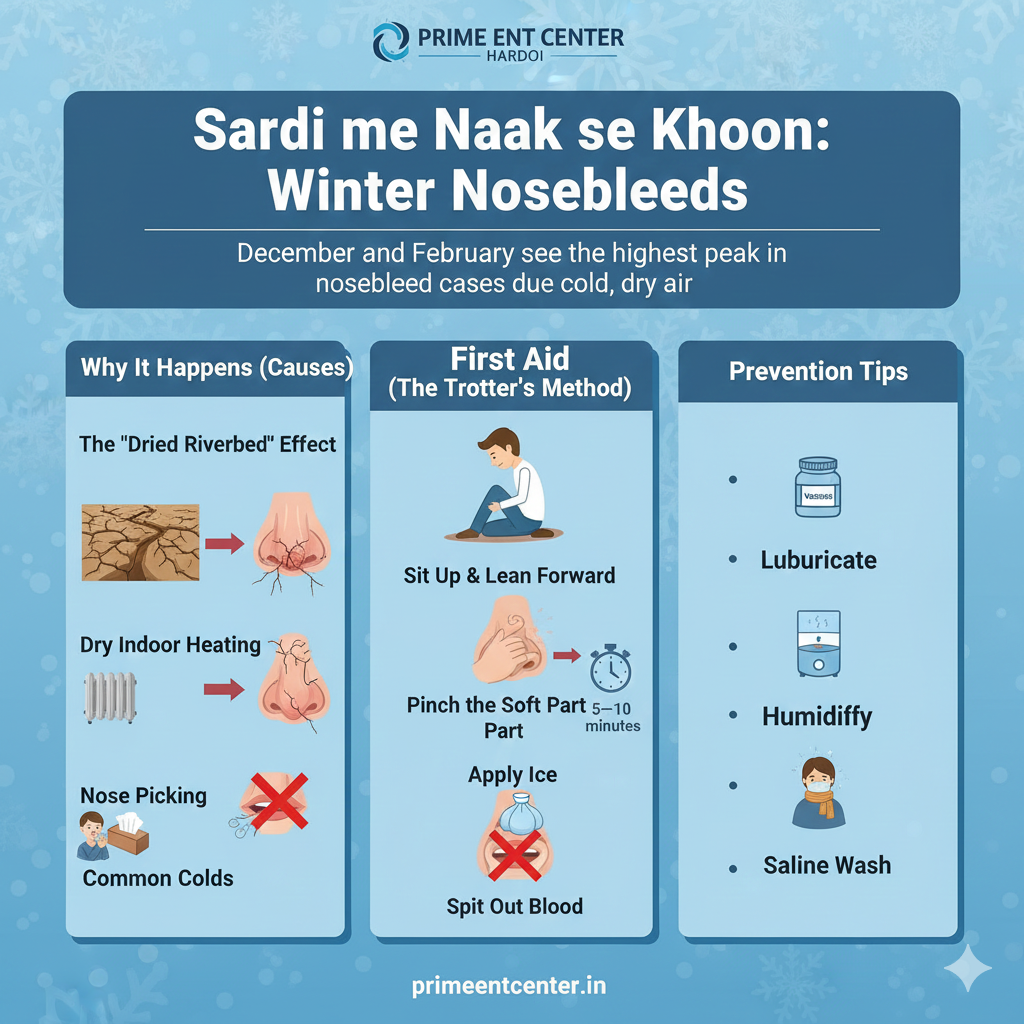
Sardi me Naak se Khoon: Winter Nosebleed – Reasons, First Aid & Prevention
Sardi आती है और PRIME ENT Center Hardoi में nosebleed के cases बहुत बढ़ जाते हैं। Medically इसे epistaxis कहते हैं, या “naak se khoon aana” Hindi में।
जबकि epistaxis साल भर हो सकता है, winter में incidence dramatically बढ़ जाता है, December और February में highest cases।
Nasal anatomy को समझना, winter triggers को जानना, और proper first-aid—यह सब important है। Dr. Prateek Porwal और Dr. Harshita Singh से सीखो।
Part 1: Vulnerable Anatomy—Why Nose Bleeds?
Nose एक highly vascularized organ है क्योंकि उसे air को heat और humidify करना है।
Little’s Area (Kiesselbach’s Plexus):
90% नोस्बलीड्स Little’s area से होती हैं । यह anterior (front) nasal septum पर होता है। इसका नाम James Lawrence Little (American surgeon, 1836-1885) के नाम पर है
Kiesselbach’s plexus एक vascular anastomosis है—five major arteries का meeting point :
- Sphenopalatine artery (septal branch) — maxillary से
- Anterior ethmoidal artery — ophthalmic से
- Greater palatine artery — maxillary से
- Superior labial artery — facial से
- Posterior ethmoidal artery (variable)
Why This Bleeds:
- Location: Front-lower septum पर, nasal vestibule के ऊपर
- Exposure: Cold, dry, humid air के extremes को face करता है
- Fragile mucosa: Tissue बहुत delicate है
- Tight space: Vessels closely packed हैं, कोई cushion नहीं
Posterior: Woodruff’s Plexus
Elderly में (>60 years), Woodruff’s plexus से bleeding हो सकती है —यह पीछे होती है, ज्यादा severe होती है, hospitalization की जरूरत हो सकती है।
Part 2: Why Winter Causes Nosebleeds
A. Dry Air—Nasal Desiccation
- Normal requirement: ~95% humidity [user input]
- Winter outdoor: 15-25% [user input]
- Winter indoor (heating): <10% [user input]
- Deficit: 80-85% कम moisture
Result:
- Protective mucus layer evaporate हो जाता है
- Crusting (scabs) बनते हैं
- Tissue crack हो जाता है
- Blood vessels expose हो जाती हैं
- Immediate bleeding
Research shows negative correlation: lower humidity = higher epistaxis (R² = 0.7794)
B. Digital Trauma—Nose Picking (Children में)
Dry crusts की itching से बच्चे नाक pick करते हैं—यह single most common cause winter epistaxis का children में [user input]।
Prevention:
- Fingernails short रखो
- Nasal lubricants use करो
- Topical antiseptic cream अगर vestibulitis हो
C. Common Cold (Viral Rhinitis)
Winter में peak season है:
- Viral infection → vascular congestion
- Nasal lining swells
- Frequent blowing → mechanical stress
- Vessels rupture
D. Hypertension & Aging
- High BP: Severity बढ़ाता है, directly cause नहीं करता [user input]
- Elderly: Fibrosis → reduced vasoconstriction ability
E. Medications
- Anticoagulants (Warfarin): Severe, spontaneous bleeding risk [user input]
- NSAIDs/Aspirin: Platelet aggregation interfere करता है [user input]
- Topical nasal sprays: Overuse → drying, septal perforation
Part 3: First Aid—Immediate Management
Step 1: Stay Calm
Anxiety बढ़ाता है blood pressure।
Step 2: Position
- Sit upright
- Lean slightly forward
- Do NOT tilt head back (blood swallow होगा → nausea)
Step 3: Pinch Nose (Direct Pressure)
- Soft part (cartilaginous ala) को pinch करो—bony bridge नहीं
- Firm pressure 5-10 minutes continuously
- Mouth से breathe करो
- Blood को spit out करो (Trotter’s method)
Success: Direct pressure control करता है 90% anterior nosebleeds
Step 4: Ice (Vasoconstriction)
- Bridge of nose या forehead पर ice pack, 10-15 min
- Cold → blood vessels narrow
Step 5: Spit Blood (Don’t Swallow)
- Swallowing → nausea और re-bleeding
Step 6: Duration
- 15 minutes में stop = controlled
- 15-20 minutes के बाद भी = medical evaluation
Part 4: Prevention—Keeping Nose Healthy
A. Humidification
- Room humidifier रात को use करो
- 30-50% humidity maintain करो (hygrometer से)
- Weekly clean करो
Outdoor Protection:
- Winter में scarf nose-mouth पर
- Pre-warm और pre-humidify करो air को
B. Nasal Emollients—Most Effective
Vaseline या Liquid Paraffin:
- Pea-sized amount को clean finger से nasal septum पर लगाओ
- Twice daily, especially bedtime
- Protective layer → no drying/crusting/itching
- Safe सभी ages के लिए
Antiseptic Cream (if vestibulitis):
- Topical antiseptic लगाओ (mupirocin, Neosporin)
- Infection treat करो, picking urge reduce करो
C. Saline/Alkaline Irrigation
Solution:
- 1 teaspoon salt
- ½ teaspoon baking soda (crusts loosen)
- 1 pinch borax (mild antiseptic)
- 180 mL warm water
Frequency: 1x daily preventively; 2-3x during active crusting
D. Healthy Habits
Avoid Nose Picking:
- Nails short रखो
- Lubricants use करो itching reduce करने के लिए
- Children educate करो
Hydration:
- 2-3 liters fluids daily
- Body को water देता है mucus production के लिए
- Avoid caffeine/alcohol (dehydrating)
Safe Blowing:
- Gently blow करो
- One nostril at a time
- Avoid forceful bilateral blowing
No Smoking:
- Ciliated epithelium damage होता है
Part 5: Red Flags—Specialist Care चाहिए
1. Uncontrollable Bleeding
- 15-20 minutes pressure के बाद भी continue → urgent evaluation
2. Recurrent Frequent Episodes
- Multiple per week या several per month → investigation need
3. Unilateral Nasal Discharge (Elderly)
- One-sided, foul-smelling, blood-stained = sinonasal malignancy red flag
- Urgent imaging (CT) और endoscopy चाहिए
4. Traumatic Injury
- Head/facial injury के बाद → nasal fracture check करो
5. Anaemia Signs
- Fatigue, pallor, dizziness = chronic blood loss
- CBC करवाओ
6. Severe Posterior Bleeding
- Blood throat में → emergency
Part 6: Medical/Surgical Options
Chemical Cautery (Silver Nitrate):
- Silver nitrate stick या TCA directly लगाओ bleeding vessel पर
- ~80% success anterior bleeding के लिए
Nasal Packing:
- Merocel sponges या ribbon gauze
- Mechanical compression
Posterior Packing/Balloons:
- Foley catheter inflate करो posterior में
- 24-48 hours hold करो
ESPAL (Endoscopic):
- Modern surgery
- Sphenopalatine artery को clip करो/cauterize करो
- >95% success
Arterial Embolization:
- Refractory bleeding के लिए
- Radiologist interventional करता है
- ~90% success
Tranexamic Acid:
- Systemic antifibrinolytic
- Clot stabilization → less re-bleeding
Part 7: “Dried Riverbed” Analogy
Nasal lining को fertile riverbed समझो।
Summer: River बहता है। Mud soft रहता है। Ecosystem healthy है।
Winter—drought: Cold, dry air = severe drought। River’s water evaporate। Mud dry, crack। Eventually fissures से “blood” bleed करता है—nosebleed।
Prevention = “Irrigation”:
- Vaseline + saline washes = riverbed को irrigate करो
- Humidifiers = valley में water redirect करो
- Cold wind से protect = harshest drought से protect करो
- First-aid pinching = dam बनाओ; जब ground bleed करे pressure दो repair के लिए
Moisture maintain करके (lubricants, saline, humidifiers) nasal “riverbed” को healthy रखो। Winter में bleeding-free रहो।
हिंदी संस्करण
सर्दी में नाक से खून: Winter Nosebleed – कारण, First Aid & Prevention
सर्दी आती है और PRIME ENT Center Hardoi में नोस्बलीड के cases बहुत बढ़ जाते हैं। Medical term है epistaxis, या “नाक से खून आना” हिंदी में।
जबकि epistaxis साल भर हो सकता है, सर्दी में occurrence dramatically बढ़ जाता है, December और February में highest cases।
Nasal anatomy को समझना, सर्दी के triggers को जानना, और proper first-aid—यह सब जरूरी है। डॉ प्रतीक पोरवाल और डॉ हर्षिता सिंह से सीखो।
Part 1: Vulnerable Anatomy—नाक से खून क्यों?
Nose एक highly vascularized organ है क्योंकि उसे air को heat और humidify करना है।
Little’s Area (Kiesselbach’s Plexus):
90% नोस्बलीड्स Little’s area से होती हैं । यह anterior (front) nasal septum पर होता है। इसका नाम James Lawrence Little (American surgeon, 1836-1885) के नाम पर है ।
Kiesselbach’s plexus एक vascular anastomosis है—five major arteries का meeting point :
- Sphenopalatine artery (septal branch) — maxillary से
- Anterior ethmoidal artery — ophthalmic से
- Greater palatine artery — maxillary से
- Superior labial artery — facial से
- Posterior ethmoidal artery (variable)
Why This Bleeds:
- Location: Front-lower septum पर, nasal vestibule के ऊपर
- Exposure: Cold, dry, humid air के extremes को face करता है
- Fragile mucosa: Tissue बहुत delicate है
- Tight space: Vessels closely packed हैं, कोई cushion नहीं
Posterior: Woodruff’s Plexus
Elderly में (>60 years), Woodruff’s plexus से bleeding हो सकती है —यह पीछे होती है, ज्यादा severe होती है, hospitalization की जरूरत हो सकती है।
Part 2: सर्दी में नोस्बलीड क्यों?
A. Dry Air—Nasal Desiccation
- Normal requirement: ~95% humidity [user input]
- Winter outdoor: 15-25% [user input]
- Winter indoor (heating): <10% [user input]
- Deficit: 80-85% कम moisture
Result:
- Protective mucus layer evaporate हो जाता है
- Crusting (scabs) बनते हैं
- Tissue crack हो जाता है
- Blood vessels expose हो जाती हैं
- Immediate bleeding
Research दिखाता है negative correlation: lower humidity = higher epistaxis (R² = 0.7794)।
B. Digital Trauma—Nose Picking (बच्चों में)
Dry crusts की itching से बच्चे नाक pick करते हैं—यह single most common cause सर्दी में epistaxis का बच्चों में ।
Prevention:
- Fingernails short रखो
- Nasal lubricants use करो
- Topical antiseptic cream अगर vestibulitis हो
C. Common Cold (Viral Rhinitis)
सर्दी में peak season है:
- Viral infection → vascular congestion
- Nasal lining swells
- Frequent blowing → mechanical stress
- Vessels rupture
D. Hypertension & बुजुर्ग
- High BP: Severity बढ़ाता है, directly cause नहीं करता
- Elderly: Fibrosis → reduced vasoconstriction ability
E. Medications
- Anticoagulants (Warfarin): Severe, spontaneous bleeding risk
- NSAIDs/Aspirin: Platelet aggregation interfere करता है
- Topical nasal sprays: Overuse → drying, septal perforation
Part 3: First Aid—Immediate Management
Step 1: शांत रहो
Anxiety बढ़ाता है blood pressure।
Step 2: Position
- Sit upright
- Lean slightly forward
- Do NOT तिलकर head back (blood swallow होगा → nausea)
Step 3: Pinch Nose (Direct Pressure)
- Soft part (cartilaginous ala) को pinch करो—bony bridge नहीं
- Firm pressure 5-10 minutes continuously
- Mouth से breathe करो
- Blood को spit out करो (Trotter’s method)
Success: Direct pressure control करता है 90% anterior nosebleeds ।
Step 4: Ice (Vasoconstriction)
- Bridge of nose या forehead पर ice pack, 10-15 min
- Cold → blood vessels narrow
Step 5: Spit Blood (Swallow न करो)
- Swallowing → nausea और re-bleeding
Step 6: Duration
- 15 minutes में stop = controlled
- 15-20 minutes के बाद भी = medical evaluation
Part 4: Prevention—Nose को Healthy रखो
A. Humidification
- Room humidifier रात को use करो
- 30-50% humidity maintain करो (hygrometer से)
- Weekly clean करो
Outdoor Protection:
- सर्दी में scarf nose-mouth पर
- Pre-warm और pre-humidify करो air को
B. Nasal Emollients—सबसे Effective
Vaseline या Liquid Paraffin:
- Pea-sized amount को clean finger से nasal septum पर लगाओ
- Twice daily, especially bedtime
- Protective layer → no drying/crusting/itching
- Safe सभी ages के लिए
Antiseptic Cream (अगर vestibulitis हो):
- Topical antiseptic लगाओ (mupirocin, Neosporin)
- Infection treat करो, picking urge reduce करो
C. Saline/Alkaline Irrigation
Solution:
- 1 teaspoon salt
- ½ teaspoon baking soda (crusts loosen)
- 1 pinch borax (mild antiseptic)
- 180 mL warm water
Frequency: 1x daily preventively; 2-3x during active crusting
D. Healthy Habits
Avoid Nose Picking:
- Nails short रखो
- Lubricants use करो itching reduce करने के लिए
- Children educate करो
Hydration:
- 2-3 liters fluids daily
- Body को water देता है mucus production के लिए
- Avoid caffeine/alcohol (dehydrating)
Safe Blowing:
- Gently blow करो
- One nostril at a time
- Avoid forceful bilateral blowing
No Smoking:
- Ciliated epithelium damage होता है
Part 5: Red Flags—Specialist Care चाहिए
1. Uncontrollable Bleeding
- 15-20 minutes pressure के बाद भी continue → urgent evaluation
2. Recurrent Frequent Episodes
- Multiple per week या several per month → investigation need
3. Unilateral Nasal Discharge (बुजुर्गों में)
- One-sided, foul-smelling, blood-stained = sinonasal malignancy red flag
- Urgent imaging (CT) और endoscopy चाहिए
4. Traumatic Injury
- Head/facial injury के बाद → nasal fracture check करो
5. Anaemia के Signs
- Fatigue, pallor, dizziness = chronic blood loss
- CBC करवाओ
6. Severe Posterior Bleeding
- Blood throat में → emergency
Part 6: Medical/Surgical Options
Chemical Cautery (Silver Nitrate):
- Silver nitrate stick या TCA directly लगाओ bleeding vessel पर
- ~80% success anterior bleeding के लिए
Nasal Packing:
- Merocel sponges या ribbon gauze
- Mechanical compression
Posterior Packing/Balloons:
- Foley catheter inflate करो posterior में
- 24-48 hours hold करो
ESPAL (Endoscopic):
- Modern surgery
- Sphenopalatine artery को clip करो/cauterize करो
- >95% success
Arterial Embolization:
- Refractory bleeding के लिए
- Radiologist interventional करता है
- ~90% success
Tranexamic Acid:
- Systemic antifibrinolytic
- Clot stabilization → less re-bleeding
Part 7: “Dried Riverbed” Analogy
Nasal lining को fertile riverbed समझो।
Summer: River बहता है। Mud soft रहता है। Ecosystem healthy है।
Winter—drought: Cold, dry air = severe drought। River’s water evaporate। Mud dry, crack। Eventually fissures से “blood” bleed करता है—nosebleed।
Prevention = “Irrigation”:
- Vaseline + saline washes = riverbed को irrigate करो
- Humidifiers = valley में water redirect करो
- Cold wind से protect = harshest drought से protect करो
- First-aid pinching = dam बनाओ; जब ground bleed करे pressure दो repair के लिए
Moisture maintain करके (lubricants, saline, humidifiers) nasal “riverbed” को healthy रखो। सर्दी में bleeding-free रहो।
FAQ: English Version (20)
- What is epistaxis, and why is it called a “nosebleed”?
Epistaxis is the medical term for active bleeding from the nasal cavity. It’s called a nosebleed because blood exits through the nostrils. While it sounds alarming, the vast majority of nosebleeds are minor and self-limited, controllable with simple first aid (direct pressure for 5–10 minutes). - What percentage of nosebleeds occur in Little’s area?
Approximately 90% of all epistaxis cases originate from Little’s area (Kiesselbach’s plexus) on the anterior nasal septum. This region is vulnerable because of its exposed location and the meeting of five major arteries. - What are the five arteries that form Kiesselbach’s plexus?
The five arteries forming Little’s area are: (1) Sphenopalatine artery (septal branch), (2) Anterior ethmoidal artery, (3) Greater palatine artery, (4) Superior labial artery, and (5) Posterior ethmoidal artery. These are watershed vessels, making the area prone to bleeding. - Why is winter associated with more nosebleeds?
Winter epistaxis peaks are caused by: (1) low environmental humidity (15–25% vs. optimal 30–50%), (2) indoor heating further drying the air, (3) viral upper respiratory infections (colds), (4) dry crusting leading to nose-picking, and (5) mechanical trauma from frequent nose-blowing. Research confirms a significant negative correlation between humidity and epistaxis incidence. - What is the difference between anterior and posterior epistaxis?
Anterior epistaxis (~90% of cases) occurs from Little’s area on the front of the nasal septum and blood flows out the nostrils. Posterior epistaxis (~5–10%) occurs from Woodruff’s plexus further back and blood flows down the throat. Posterior bleeds are more severe, harder to control, and more likely to require hospitalization. - Why does the nasal mucosa require 95% humidity to function correctly?
The nasal mucosa produces a thin layer of mucus (sol layer) that allows cilia to beat and clear secretions. When humidity drops below 30%, this mucus layer evaporates, the tissue dries out, crusts form, and underlying blood vessels become exposed and friable. Very low humidity (<10%) can cause the mucosa to crack and bleed directly. - Is nose-picking the most common cause of winter nosebleeds in children?
Yes. In children, digital trauma (nose-picking) is the single most common cause of epistaxis, especially in winter when dry crusts form in Little’s area. The itching from crusts triggers picking, which ruptures exposed blood vessels. Prevention involves keeping nails short, using nasal lubricants, and educating children about not picking. - How does the common cold (viral rhinitis) trigger nosebleeds?
Viral infections cause nasal blood vessels to become congested (engorged) and the mucosa to swell. Patients then blow their nose repeatedly to clear secretions. The mechanical stress from forceful nose-blowing can rupture these already-congested, inflamed vessels, leading to epistaxis. - Does high blood pressure (hypertension) directly cause nosebleeds?
No, hypertension does not directly cause nosebleeds to start. However, once a nosebleed has begun, high blood pressure significantly increases the severity and duration of bleeding by maintaining higher arterial pressure through the ruptured vessel. Controlling blood pressure is important for patients prone to recurrent epistaxis. - Why do elderly patients more often have posterior (back) nosebleeds?
In aging, blood vessels undergo fibrosis (stiffening and scarring), which impairs their ability to constrict and close off bleeding. Additionally, posterior vessels are larger and more muscular. Elderly patients with posterior epistaxis have higher bleeding volumes and longer bleeding times. - What medications increase the risk of nosebleeds?
Anticoagulants (Warfarin, NOACs/TSOACs), antiplatelet agents (Aspirin, NSAIDs), and overused topical nasal sprays (steroids, decongestants beyond 5 days) all increase epistaxis risk. Patients on these medications should seek prompt evaluation for any nosebleed, as bleeding may be more severe and harder to control. - What is the correct first-aid technique for a nosebleed?
The evidence-based technique is: (1) Sit upright and lean slightly forward, (2) Pinch the soft (cartilaginous) part of the nose firmly between thumb and index finger, (3) Maintain pressure for 5–10 minutes continuously without checking, (4) Breathe through the mouth, (5) Spit out blood (don’t swallow). This approach controls ~90% of anterior nosebleeds. - Why shouldn’t you tilt your head back during a nosebleed?
Tilting the head back causes blood to flow down the throat instead of out the nostrils. Swallowing blood causes nausea and vomiting, increases intracranial pressure, and can restart bleeding. Additionally, blood pooling in the throat raises aspiration risk, especially in elderly or sedated patients. - How long should you apply direct pressure to a nosebleed before assuming it won’t stop?
Apply firm pressure for at least 5–10 minutes before checking. If bleeding continues beyond 15–20 minutes of continuous pressure, the source is likely posterior or arterial, and medical evaluation is warranted. Most anterior bleeds stop within 15 minutes of proper direct pressure. - What is Vaseline’s role in preventing winter nosebleeds?
Vaseline (petroleum jelly) or liquid paraffin oil, applied twice daily to the nasal septum, creates a protective barrier that prevents mucosal drying and crusting. This lubricant reduces itching (and thus nose-picking), keeps tissue moist, and is the single most effective prevention strategy for winter nosebleeds in children and adults. - Can saline irrigation remove crusts without causing bleeding?
Yes. A warm alkaline/saline solution (containing sodium chloride, sodium bicarbonate, and sodium biborate) gently softens and loosens adherent crusts without traumatizing blood vessels. Regular saline irrigation is safe and can be used 1–3 times daily. It prevents crusting and reduces the urge to pick. - What is the “Trotter’s method,” and why is it recommended for nosebleeds?
Trotter’s method means breathing quietly through the mouth and spitting out any blood that drains into the throat. This prevents nausea, vomiting, and airway compromise from swallowing blood. It’s especially important for patients sitting upright and leaning forward during a bleed. - When is silver nitrate cautery used for epistaxis, and how effective is it?
Silver nitrate cautery is applied to bleeding vessels in Little’s area when direct pressure fails or for recurrent anterior bleeding. A silver nitrate stick is touched to the vessel, causing chemical necrosis and sealing. Success rate is approximately 80% for anterior epistaxis, and it can be performed in an office setting without anesthesia. - What is endoscopic sphenopalatine artery ligation (ESPAL), and when is it used?
ESPAL is a modern surgical technique where the sphenopalatine artery (main blood supply to the posterior nose) is clipped or cauterized under endoscopic visualization. It’s used for recurrent or intractable posterior epistaxis not controlled by packing or cautery. Success rate exceeds 95%, with faster recovery than traditional surgical ligation. - What are the red flags that require urgent ENT specialist evaluation for a nosebleed?
Red flags include: (1) uncontrollable bleeding after 15–20 minutes of pressure, (2) recurrent frequent episodes (multiple per week), (3) unilateral foul-smelling blood-stained discharge in elderly (possible malignancy), (4) traumatic injury with possible fracture, (5) signs of anemia (fatigue, pallor, dizziness), and (6) severe posterior bleeding flowing down the throat.
Hinglish FAQs
- Epistaxis kya hota hai, aur “nosebleed” kyun kehte hain?
Epistaxis nasal cavity se active bleeding ko kehte hain. Isko “nosebleed” isliye bolte hain kyunki blood nostrils se bahar aata hai. Zyada tar cases minor hote hain aur simple first aid—soft part of nose ko pinch karke 5–10 minutes tak lagatar pressure—se control ho jaate hain. - Little’s area se kitne percent nosebleeds hoti hain?
Lagbhag 90% nosebleeds Little’s area (Kiesselbach’s plexus) se hoti hain. Ye area exposed location aur multiple arteries ke junction ki wajah se vulnerable hota hai. - Kiesselbach’s plexus (Little’s area) ko kaun‑kaun si arteries supply karti hain?
Main branches: sphenopalatine artery (septal branch), anterior ethmoidal artery, greater palatine artery, superior labial artery, aur posterior ethmoidal artery. In arteries ka junction is area ko bleeding‑prone banata hai. - Winter me nosebleeds zyada kyun hoti hain?
Winter me low humidity aur indoor heating se nasal mucosa dry ho jaati hai, crusting hoti hai aur chhoti trauma/picking se vessels easily rupture kar sakti hain. Saath hi viral colds aur frequent nose‑blowing bhi bleeding trigger kar sakte hain. winter nosebleeds - Anterior aur posterior epistaxis me kya difference hai?
Anterior epistaxis zyada common hoti hai aur usually Little’s area (front septum) se bleeding hoti hai, jo nostrils se bahar aati hai. Posterior epistaxis comparatively less common hoti hai, bleeding throat me ja sakti hai aur control karna harder hota hai; hospitalization/packing ki zarurat zyada pad sakti hai. winter nosebleeds - Nasal mucosa ko high humidity kyun chahiye hoti hai?
Nasal mucosa ek protective mucus layer maintain karti hai. Dryness me mucus evaporate hota hai, tissue dry/cracked hoti hai aur vessels exposed/friable ho sakti hain, jisse bleeding ka risk badhta hai. - Kya bachchon me winter nosebleed ka sabse common cause nose‑picking hai?
Haan. Children me dry crusts ki itching se nose‑picking hoti hai, jo exposed vessels ko injure karke bleeding start kar sakti hai. Prevention me nails short rakhna, nasal lubrication aur habit counseling helpful hai. - Common cold (viral rhinitis) nosebleed kaise trigger karta hai?
Cold me nasal mucosa inflamed aur congested ho jaati hai. Patient bar‑bar nose blow karta hai, aur forceful blowing se inflamed vessels rupture ho sakti hain. - Kya high BP (hypertension) directly nosebleed cause karta hai?
Nahi. High BP usually nosebleed start nahi karata, lekin bleed start hone ke baad severity/duration badha sakta hai. Recurrent epistaxis wale patients me BP control important hota hai. - Elderly patients me posterior (back) nosebleeds zyada kyun hoti hain?
Aging me vessels stiff ho sakti hain aur bleeding control difficult ho sakta hai. Posterior bleeds me bleeding throat me ja sakti hai, volume zyada ho sakta hai aur medical intervention ki need badh jaati hai. - Kaunsi medicines nosebleed ka risk badhati hain?
Anticoagulants (warfarin/DOACs), antiplatelets (aspirin), aur NSAIDs bleeding risk badhate hain. Kuch patients me overuse of topical nasal sprays/mucosal dryness bhi risk badha sakti hai. - Nosebleed ka correct first‑aid technique kya hai?
Sit upright, slightly forward lean karo, soft cartilaginous part (ala) ko firmly pinch karo, 5–10 minutes continuous pressure do without checking, mouth se breathe karo, aur blood swallow na karo—spit out karo. - Nosebleed me head back kyun nahi karna chahiye?
Head back karne se blood throat me chala jata hai, jisse nausea/vomiting ho sakta hai aur aspiration ka risk badh sakta hai. Forward lean safer hota hai. - Direct pressure kitni der lagani chahiye?
Kam se kam 5–10 minutes continuous. Agar 15–20 minutes ke baad bhi bleeding continue ho, to medical evaluation karwana chahiye. - Vaseline winter nosebleeds prevent karne me kaise help karti hai?
Petroleum jelly/liquid paraffin nasal mucosa ko moisturize karti hai, crusting aur irritation kam karti hai, aur nose‑picking/trauma ka risk reduce karke bleeding episodes prevent karne me help kar sakti hai. - Kya saline irrigation crusts remove kar sakta hai bina bleeding ke?
Haan, gentle warm saline/alkaline rinse crusts ko soften karke gently remove karne me help karta hai. Forceful flushing avoid karo. - “Trotter’s method” kya hota hai?
Isme patient upright baithta hai, forward lean karta hai, mouth se breathe karta hai aur throat me aane wala blood swallow karne ke bajay spit out karta hai. - Silver nitrate cautery kab use hoti hai aur kitni effective hoti hai?
Jab anterior bleeding point clearly dikhta ho aur recurrent/persistent bleeding ho, tab silver nitrate cautery se vessel ko seal kiya ja sakta hai. Ye many anterior cases me effective hoti hai. - ESPAL kya hota hai aur kab use hota hai?
ESPAL (endoscopic sphenopalatine artery ligation) ek surgical procedure hai jo refractory ya severe posterior epistaxis me kiya jata hai jab packing/cautery se control na ho. - Nosebleed me kaun‑kaun se red flags hain jisme urgent ENT consult chahiye?
Bleeding 15–20 minutes pressure ke baad bhi na rukna, bar‑bar frequent episodes, suspected posterior bleed (blood throat me), trauma, severe weakness/dizziness, anemia symptoms, ya unilateral persistent blood‑stained discharge.
Hindi FAQs
- Epistaxis क्या होता है, और इसे “nosebleed” क्यों कहते हैं?
Epistaxis नाक की गुहा से सक्रिय रक्तस्राव को कहते हैं। इसे nosebleed इसलिए कहते हैं क्योंकि खून नाक के छिद्रों से बाहर आता है। ज़्यादातर नोस्बलीड्स मामूली होती हैं और soft part को पकड़कर 5–10 मिनट लगातार दबाव देने जैसी first aid से नियंत्रित हो जाती हैं। - Little’s area से कितना प्रतिशत नोस्बलीड होती है?
लगभग 90% नोस्बलीड्स Little’s area (Kiesselbach’s plexus) से होती हैं। यह क्षेत्र exposed location और कई धमनियों के junction के कारण अधिक vulnerable होता है। - Kiesselbach’s plexus (Little’s area) किन धमनियों से बनता/सप्लाई होता है?
मुख्य धमनियाँ: sphenopalatine artery (septal branch), anterior ethmoidal artery, greater palatine artery, superior labial artery और posterior ethmoidal artery। इनका junction इस क्षेत्र को bleeding‑prone बनाता है। - सर्दियों में नाक से खून ज्यादा क्यों आता है?
सर्दियों में humidity कम होने और indoor heating से nasal mucosa सूख जाती है, crusting होती है और हल्की चोट/पिकिंग से vessels आसानी से rupture हो सकती हैं। साथ ही वायरल सर्दी और बार‑बार नाक झाड़ना/ब्लो करना भी bleeding trigger कर सकता है। - Anterior और posterior epistaxis में क्या अंतर है?
Anterior epistaxis अधिक common होती है और आमतौर पर नाक के आगे वाले हिस्से (Little’s area) से होती है, खून नाक से बाहर आता है। Posterior epistaxis कम common लेकिन अधिक गंभीर हो सकती है, खून गले की तरफ जा सकता है और control करना मुश्किल होता है; hospitalization/packing की जरूरत ज्यादा पड़ सकती है। - Nasal mucosa को high humidity क्यों चाहिए?
Nasal mucosa एक protective mucus layer बनाए रखती है। Dryness में mucus evaporate होता है, tissue dry/cracked हो जाती है और blood vessels exposed/friable हो सकती हैं, जिससे bleeding का risk बढ़ता है। - क्या बच्चों में सर्दी के दौरान nose‑picking सबसे common कारण है?
हाँ। सूखे crusts की itching से बच्चे नाक में उंगली डालते हैं, जिससे exposed vessels injure होकर bleeding शुरू हो सकती है। Prevention में नाखून छोटे रखना, nasal lubrication और habit counseling मददगार है। - Common cold (viral rhinitis) नाक से खून कैसे कराता है?
Viral cold में nasal mucosa inflamed और congested हो जाती है। मरीज बार‑बार/जोर से नाक blow करता है, जिससे inflamed vessels rupture हो सकती हैं। - क्या हाई BP (hypertension) सीधे नोस्बलीड कराता है?
नहीं। High BP आमतौर पर nosebleed शुरू नहीं कराता, लेकिन bleed शुरू होने के बाद severity/duration बढ़ा सकता है। Recurrent epistaxis वाले मरीजों में BP control जरूरी है। - बुजुर्गों में posterior (पीछे) नोस्बलीड ज्यादा गंभीर क्यों होती है?
उम्र बढ़ने पर vessels stiff हो सकती हैं और bleeding control कठिन हो सकता है। Posterior bleed में खून गले की तरफ जा सकता है, मात्रा ज्यादा हो सकती है और medical intervention की जरूरत बढ़ जाती है। - कौन‑सी दवाएँ नोस्बलीड का risk बढ़ाती हैं?
Anticoagulants (warfarin/DOACs), antiplatelets (aspirin) और NSAIDs bleeding risk बढ़ाते हैं। कुछ मरीजों में topical nasal sprays का overuse/mucosal dryness भी risk बढ़ा सकता है। - Nosebleed के लिए सही first‑aid technique क्या है?
Upright बैठें, थोड़ा आगे झुकें, नाक के soft cartilaginous भाग (ala) को firmly पकड़कर दबाएँ, 5–10 मिनट बिना छोड़े दबाव रखें, mouth से सांस लें, और खून न निगलें—थूक दें। - Nosebleed में सिर पीछे क्यों नहीं करना चाहिए?
सिर पीछे करने से खून गले में चला जाता है, जिससे nausea/vomiting हो सकता है और aspiration का risk बढ़ सकता है। Forward lean करना safer होता है।winter nosebleeds - Direct pressure कितनी देर तक देना चाहिए?
कम से कम 5–10 मिनट लगातार। अगर 15–20 मिनट के बाद भी bleeding जारी रहे तो medical evaluation कराना चाहिए। - Vaseline सर्दी में नोस्बलीड रोकने में कैसे मदद करती है?
Petroleum jelly/liquid paraffin nasal mucosa को moisturize करती है, crusting और irritation कम करती है, और nose‑picking/trauma का risk घटाकर bleeding episodes prevent करने में मदद कर सकती है। - क्या saline irrigation से crusts हट सकते हैं बिना bleeding के?
हाँ, gentle warm saline/alkaline rinse crusts को soften करके धीरे‑धीरे हटाने में मदद करता है। बहुत जोर से flushing avoid करें। - “Trotter’s method” क्या है?
इसमें मरीज upright बैठता है, आगे झुकता है, mouth से सांस लेता है और गले में आने वाला खून निगलने के बजाय थूक देता है। - Silver nitrate cautery कब की जाती है और कितनी effective है?
जब anterior bleeding point स्पष्ट दिखे और recurrent/persistent bleeding हो, तब silver nitrate cautery से vessel seal की जा सकती है। यह कई anterior cases में effective होती है। winter nosebleeds - ESPAL क्या है और कब किया जाता है?
ESPAL (endoscopic sphenopalatine artery ligation) एक surgical procedure है जो refractory या severe posterior epistaxis में किया जाता है जब packing/cautery से control न हो। winter nosebleeds - Nosebleed में कौन‑से red flags हैं जिनमें urgent ENT consult चाहिए?
15–20 मिनट दबाव देने के बाद भी bleeding न रुकना, बार‑बार frequent episodes, posterior bleed का suspicion (खून गले में जाना), trauma, बहुत ज्यादा कमजोरी/चक्कर, anemia symptoms, या एक तरफ लगातार blood‑stained discharge.
PRIME ENT Center Hardoi – Winter Nosebleed Care
Address: PRIME ENT Center Hardoi, Hardoi 241001 (Uttar Pradesh), India
For Acute Nosebleeds (First Aid): Pinching technique guidance, ice pack application, observation for re-bleeding
For Recurrent Winter Nosebleeds: Nasal endoscopy evaluation, possible silver nitrate cautery, Vaseline/emollient counseling, humidifier recommendations, winter nosebleeds
For Severe/Uncontrollable Bleeding: Nasal packing (Merocel/gauze), possible CT imaging, tranexamic acid, evaluation for coagulopathy or malignancy, winter nosebleeds, winter nosebleeds
For Posterior Epistaxis: Posterior packing, balloon catheter, endoscopic ligation (ESPAL), arterial embolization consultation, winter nosebleeds
What to Bring:
- Timeline of bleeding episodes (frequency, duration, seasonal pattern)
- List of medications (especially anticoagulants, aspirin, NSAIDs, nasal sprays)
- History of trauma or nasal surgery
- Blood pressure readings (if available)
- Previous imaging or endoscopy reports
Trust PRIME ENT Center Hardoi for Expert Winter Nosebleed Management and Long-Term Prevention Strategies
Secondary Keywords (Comma-Separated):
epistaxis winter season incidence, Little’s area Kiesselbach plexus 90%, anterior epistaxis bleeding, posterior epistaxis Woodruff plexus, nasal septal bleeding, dry air nasal mucosa drying, digital trauma nose picking children, Kiesselbach’s plexus arterial anastomosis, first aid nosebleed pinch technique, ice pack nasal vasoconstriction, head position forward lean, nasal packing Merocel gauze, silver nitrate cautery chemical, tranexamic acid clotting stabilization, nasal emollients Vaseline liquid paraffin, saline irrigation alkaline wash crusts, anticoagulant warfarin bleeding risk, aspirin NSAID platelet aggregation, topical decongestant steroid spray overuse, seasonal epistaxis peaks December February, winter humidity low desiccation, pediatric epistaxis nose picking common cause, elderly posterior epistaxis recurrent bleeding, unilateral nasal discharge malignancy, sinonasal cancer warning signs, nasal packing complications airway, epistaxis-balloon-catheter foley, sphenopalatine artery ligation ESPAL endoscopic, arterial embolization refractory bleeding, nasal trauma fracture bleeding, anaemia symptoms fatigue pale dizziness, red flags epistaxis emergency