
Table of Contents
English Version
Bell’s Palsy in Winter (Thandi Hawa): Understanding Cold Air, Recognizing Symptoms, and Knowing When to Seek Emergency Care
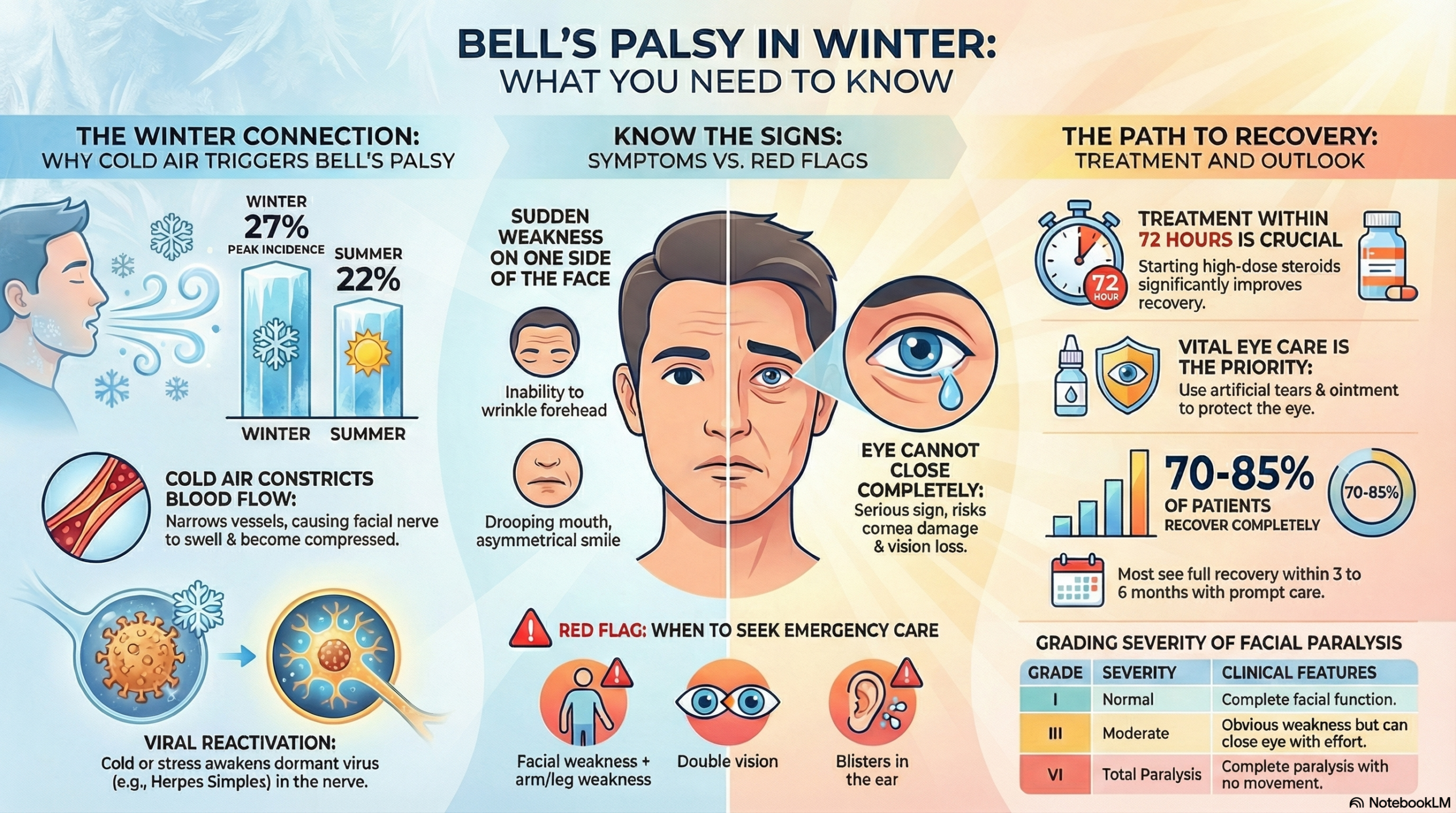
Bell’s Palsy during winter (thandi hawa) is the most common cause of acute facial weakness. This condition accounts for approximately 70% of all facial paralysis cases and has a well-documented association with cold air exposure. During winter months, we observe a marked increase in Bell’s palsy cases at PRIME ENT Center Hardoi—a pattern confirmed by global research showing a 27% peak incidence during winter compared to 22% in summer.
The condition often presents after patients report a history of exposure to cold winds, a draught on the side of the face, or washing the face with cold water. While the exact mechanism remains debated in medical literature, the association between cold air (“thandi hawa”) and Bell’s palsy is so well-recognised that it appears consistently in both historical medical texts and modern otolaryngology practice. Understanding why this happens, how to identify the early signs, and when to seek immediate medical attention can be the difference between full recovery and lasting complications.
Why Does Cold Air Trigger Bell’s Palsy? The Science Behind “Thandi Hawa”
The facial nerve (the cranial nerve VII) has the longest and most tortuous course through a bony canal of any nerve in the human body. This anatomical vulnerability makes it uniquely susceptible to pressure and inflammation.
The Ischaemic Theory (Blood Flow Blockage)
One of the primary explanations for the winter effect is the ischaemic theory. Exposure to extreme cold or a sudden cold blast causes vasospasm—a narrowing of the blood vessels supplying the facial nerve, particularly near the stylomastoid foramen. This leads to a cascade of events:
- Reduced blood flow (ischaemia) to the nerve tissue
- Oedema (swelling) developing within and around the nerve
- Compression of the already swollen nerve within the rigid, narrow bony canal
- Progressive loss of nerve conduction, leading to paralysis
Dr. Prateek Porwal often explains this mechanism to patients using an analogy: imagine a water hose inside a rigid steel pipe. When the hose swells due to inflammation, it gets pinched. The narrower the original space, the faster the flow stops.
The Viral Reactivation Theory (HSV-1 Involvement)
Modern research suggests that the primary underlying cause is often the reactivation of a latent virus, most notably Herpes Simplex Virus (HSV-1). This virus remains dormant in the facial nerve tissue and may “awaken” due to triggers such as:
- Extreme temperature changes (cold winter air)
- Physical or emotional stress
- Concurrent viral infections
- Immune system suppression
Once active, the virus causes inflammation and swelling of nerve tissue, leading to the same entrapment neuropathy mechanism. This explains why some patients with Bell’s palsy respond better to antiviral medications in addition to steroids.
Recognizing the Symptoms: What Bell’s Palsy Looks Like
Bell’s palsy typically affects only one side of the face (unilateral) and develops rapidly, often peaking within 48 to 72 hours of onset. Early recognition is critical because treatment efficacy depends heavily on starting medications within the first 72 hours.
Facial Movement and Appearance Changes
The most characteristic sign is the loss of forehead wrinkles on the affected side. Unlike a stroke, which typically spares the forehead movement, Bell’s palsy affects the entire facial nerve distribution. Key signs include:
- Inability to wrinkle the forehead on the affected side
- Drooping of the mouth corner on the weak side, creating a crooked appearance
- Asymmetrical smile when asked to show teeth; the mouth deviates toward the normal side
- Inability to whistle, puff cheeks, or perform mouth movements
These signs occur because the facial muscles (orbicularis oris, buccinator, and others) are innervated by the facial nerve and lose function when the nerve is compressed.
Eye-Related Complications (Most Concerning)
The eye complications are among the most serious aspects of Bell’s palsy:
- Incomplete eye closure: The patient cannot close the affected eye completely, leaving the white of the eye (sclera) exposed
- Bell’s Phenomenon: When attempting to close the eye, the eyeball rolls upward and outward (a protective reflex), but the eyelid fails to follow
- Epiphora (Excessive Tearing): Paradoxically, tears overflow down the cheek because the lower eyelid becomes lax and the “tear pump” (blinking mechanism) fails
- Dry Eyes: The cornea becomes dangerously dry because the eyelids cannot spread the tear film adequately, risking corneal ulcers and permanent vision loss
Dr. Harshita Singh emphasises that eye care is not optional—it is the priority treatment measure in Bell’s palsy. Corneal scarring can occur within days if not managed properly.
Sensory and Auditory Changes
Patients often report:
- Hyperacusis (Sound Sensitivity): Sounds seem abnormally loud or even painful in the ear on the affected side because the nerve to the stapedius muscle (which dampens loud sounds) is paralysed
- Altered or Loss of Taste: Many patients notice loss of taste or altered taste on the anterior two-thirds of the tongue
- Post-Auricular Pain: Dull, aching pain behind the ear (mastoid area) often precedes or accompanies the onset of paralysis
Red Flags: When You Must Seek Immediate Medical Attention
While Bell’s palsy itself is often self-limiting (meaning it resolves on its own over time), several “sinister signs” demand immediate evaluation:
1. Vesicles (Blisters) in the Ear Canal
If the facial paralysis is accompanied by painful blisters in the ear canal or on the outer ear (auricle), this suggests Ramsay Hunt Syndrome (Herpes Zoster Oticus). This is a more severe variant of facial paralysis and requires different, more aggressive treatment. Ramsay Hunt syndrome has a lower spontaneous recovery rate compared to typical Bell’s palsy and may require longer antivirals and higher-dose steroids.
2. Bilateral Facial Weakness (Both Sides of Face)
If both sides of the face are weak or paralysed, this is rarely Bell’s palsy and suggests a serious systemic condition such as:
- Lyme disease (tick-borne)
- Sarcoidosis (autoimmune granulomatous disease)
- Guillain-Barré Syndrome (acute paralysis)
- HIV infection
- Leukemia or lymphoma
Bilateral facial paralysis warrants immediate neurological and systemic evaluation.
3. Additional Neurological Deficits
If you experience any of the following alongside facial paralysis, you may be having a stroke or have a brainstem lesion:
- Double vision (diplopia)
- Difficulty swallowing (dysphagia)
- Slurred or unclear speech
- Weakness in arms or legs
- Loss of consciousness or severe headache
These signs require emergency evaluation and imaging (CT or MRI).
4. No Signs of Recovery After 3–6 Weeks
Most Bell’s palsy cases show some improvement within 2 to 3 weeks. If there is no change after one month, or if the weakness is progressively worsening over many weeks, a tumour (such as a parotid gland tumour or facial nerve schwannoma) must be ruled out. Imaging is mandatory in these cases.
5. Ear Discharge or Hearing Loss
If facial palsy occurs alongside a draining ear or significant sudden hearing loss, this may indicate:
- Complications of middle ear infection
- Cholesteatoma (eroding bone disease of the ear)
- Acute mastoiditis
These conditions require prompt antibiotic treatment and possibly surgery.
Diagnosis: How PRIME ENT Center Hardoi Evaluates Bell’s Palsy
At PRIME ENT Center Hardoi, our diagnostic approach combines clinical assessment with objective testing to confirm Bell’s palsy and determine its severity and prognosis.
Clinical Grading: The House-Brackmann Scale
We use the House-Brackmann Facial Paralysis Scale, the gold standard recognised by the American Academy of Otolaryngology-Head & Neck Surgery. This 6-point scale objectively quantifies the degree of paralysis:
| Grade | Severity | Clinical Features |
|---|---|---|
| I | Normal | Complete facial function |
| II | Mild Dysfunction | Slight weakness visible only on close inspection; can close eye easily |
| III | Moderate Dysfunction | Obvious but not disfiguring weakness; can close eye with effort |
| IV | Moderately Severe | Obvious disfiguring weakness; cannot close eye completely |
| V | Severe Dysfunction | Barely perceptible muscle movement |
| VI | Total Paralysis | Complete flaccid paralysis; no movement |
Diagnostic Tests We Perform
Audiometry: We assess hearing function because damage to the acoustic nerve (which travels with the facial nerve) can occur.
Schirmer’s Test: A small paper strip is placed in the eye to measure tear production. A 50% reduction on the affected side suggests the lesion is high up near the brain.
Facial Nerve Conduction Studies (ENoG): Performed between 3 and 14 days after onset to measure the percentage of nerve fibre degeneration. This helps predict whether the nerve will recover on its own or if additional intervention may be needed. A greater than 90% degeneration on the first assessment may indicate need for consideration of surgical decompression.
Imaging (MRI/CT): Not routinely needed for typical cases, but mandatory if:
- Recovery is delayed beyond expected timeframes
- There are atypical features suggesting tumour or fracture
- You have recurrent Bell’s palsy (suggesting possible tumour)
Dr. Prateek Porwal emphasises that early imaging is not always necessary, but it becomes essential if the clinical picture doesn’t match classic Bell’s palsy.
Treatment: Restoring Nerve Function and Protecting the Eye
The goal of treatment is twofold: reduce inflammation of the facial nerve and protect the eye from irreversible damage.
Medications: The Cornerstone of Treatment
Corticosteroids (Prednisolone): This is the mainstay of treatment. High-dose steroids should ideally be started within 72 hours of onset to reduce nerve swelling and compression. A typical regimen is Prednisolone 50–60 mg daily for 5 days, followed by a 5-day taper. Starting steroids after 96 hours significantly reduces the recovery rate, emphasising the importance of immediate evaluation.
Antiviral Drugs (Acyclovir or Valacyclovir): Often prescribed in combination with steroids, especially for:
- Severe cases (House-Brackmann Grade IV–VI)
- Suspected Ramsay Hunt syndrome
- Patients with immunosuppression
Antivirals alone are ineffective and should never be used without corticosteroids.
B-Complex Vitamins and Vasodilators: Some specialists prescribe these to aid nerve regeneration and improve blood flow, though evidence is mixed. At PRIME ENT Center Hardoi, we may recommend these as adjunctive therapy depending on individual cases.
Vital Eye Care (Most Important)
Because the eye cannot close properly, it is at high risk for corneal ulcers and permanent vision loss. Eye care takes priority:
- Artificial Tears: Use frequently during the day to keep the eye moist
- Eye Ointment and Patching: Apply thick lubricating ointment (like lubricant eye ointment) and secure an eye pad or adhesive tape to keep the eye shut during sleep
- Protective Eyewear: Wear protective glasses or goggles during the day to prevent dust, wind, and debris from striking the exposed cornea
- Avoid Dry Environments: Stay away from air conditioning and heating that dries the eye
Dr. Harshita Singh stresses: “Neglecting eye care is one of the most common reasons for poor outcomes. Patients recover facial movement but are left with corneal scarring and reduced vision. This is entirely preventable.”
Physiotherapy and Supportive Care
- Moist Heat: Apply a warm, damp cloth over the face for 15–20 minutes, several times daily, to relieve pain and improve circulation
- Facial Exercises: Once movement begins to return (usually within 2–3 weeks), active exercises help maintain muscle tone. These include grinning, whistling, wrinkling the forehead, and closing the eye forcefully
- Massage: Gentle facial massage may improve circulation and prevent muscle atrophy
Surgical Intervention
Surgery is rare for uncomplicated Bell’s palsy. However, surgical decompression of the facial nerve may be considered if:
- Electrical tests (ENoG) show more than 90% degeneration within the first two weeks
- There is no sign of any recovery after 3–4 weeks of medical treatment
- The patient is evaluated by a specialist experienced in facial nerve surgery
Surgical decompression is controversial and not routinely recommended, but selected cases benefit from it.
What to Expect: Prognosis and Recovery Timeline
The outlook for Bell’s palsy is generally excellent:
- 70–85% of patients recover completely or with very minimal weakness within 3 to 6 months
- Most improvement occurs within the first 6 weeks, with significant changes visible week-to-week
- Patients with partial paralysis (paresis) have nearly 100% recovery rate
- Children and pregnant women have recovery rates up to 90%
Recovery Timeline
| Timeframe | Expected Progress |
|---|---|
| Days 1–7 | Rapid onset; paralysis peaks at 48–72 hours |
| Weeks 2–4 | Early signs of recovery may appear; tingling or slight movement |
| Weeks 4–8 | Visible improvement; mouth movement and forehead wrinkles return |
| Weeks 8–12 | Substantial recovery; most patients regain 80%+ function |
| Months 4–6 | Near-complete or complete recovery in 70–85% of cases |
| Months 6–12 | Final remodelling; synkinesis (abnormal co-contractions) may develop |
Potential Complication: Synkinesis
In about 10–15% of incompletely recovered cases, synkinesis develops. This is abnormal regeneration of nerve fibres into the wrong muscles, causing involuntary co-contraction. For example, when the patient smiles, the eye may close involuntarily. This is cosmetically bothersome but functional vision is preserved.
When to Contact PRIME ENT Center Hardoi
Seek immediate evaluation (same day or next day) if:
- Sudden facial weakness or drooping appears
- You cannot close your eye on one side
- Your mouth is drooping
- You notice vesicles (blisters) in your ear
Seek emergency care if:
- You have facial weakness plus double vision, slurred speech, or arm/leg weakness (possible stroke)
- You have difficulty swallowing or breathing
- You have bilateral facial weakness
- You have severe ear pain with fever and facial paralysis (possible mastoiditis or severe infection)
Schedule a routine appointment within 1–2 weeks if:
- You have had facial weakness for more than a week without improvement
- You have completed treatment but movement has plateaued
- You are concerned about cosmetic appearance during recovery
Prevention: Can You Reduce Your Risk?
While complete prevention is not possible, these measures may reduce risk during winter:
- Avoid direct cold wind exposure to the face; use scarves or face masks in cold weather
- Keep face warm and dry; dry your face gently after washing, especially in winter
- Manage stress through relaxation, adequate sleep, and exercise
- Maintain immune health with balanced nutrition, vitamins (especially B vitamins), and regular exercise
- Treat concurrent infections promptly; viral infections may trigger viral reactivation
The Key Takeaway
Bell’s palsy, while frightening, is usually a temporary condition. However, early recognition and prompt treatment within 72 hours are critical for optimal outcomes. At PRIME ENT Center Hardoi, we understand the anxiety this condition causes. With proper medical management, eye care, and physiotherapy, the vast majority of patients recover fully and return to normal life.
Do not delay—if you notice sudden facial weakness this winter, contact PRIME ENT Center Hardoi immediately.
Hinglish Version
Sardi me Bell’s Palsy (Thandi Hawa): Lakshan Samjhiye, Kab Doctor Dikhaye?
Bell’s palsy ek bahut common aur serious condition hai jo thandi hawa (cold air) ke wajah se hota hai. Yeh 70% facial paralysis cases mein hota hai. Sardi ke mahino mein (December se February tak) Bell’s palsy ke cases mein 27% tak badhti hai, jo ki gareeb mein sirf 22% hoti hai.
Is article mein hum samjhenge ki yeh condition kya hota hai, symptoms kya hote hain, aur sab se important—kab aap ko doctor dikhana chahiye. At PRIME ENT Center Hardoi, Dr. Prateek Porwal aur Dr. Harshita Singh har saal sardi me bahut se Bell’s palsy ke patients ko dekha karte hain.
Thandi Hawa Bell’s Palsy Ko Kaise Trigger Karta Hai? Science Samjhiye
Facial nerve (7th cranial nerve) sabse lambi aur ek narrow bone tunnel se jati hai. Yeh anatomy isey bahut vulnerable banata hai swelling aur compression ke liye.
Ischaemic Theory (Blood Flow Ka Kam Hona)
Jab aap ko bahut thandi hawa ya cold water ka contact hota hai, to face ki blood vessels ekdum narrow ho jati hain (vasospasm). Isse kya hota hai:
- Facial nerve ko blood supply kam ho jata hai (ischaemia)
- Nerve mein swelling (oedema) ho jata hai
- Yeh swelling wali nerve rigid bone canal ke andar ka compress ho jata hai
- Isse nerve ka signal body ke muscles tak nahi pahunchta aur paralysis ho jata hai
Dr. Prateek Porwal iska comparison aise dete hain—sochiye ek water hose jo ki steel pipe ke andar hai. Jab hose swell kare to pipe tight ho jaati hai aur pani bahar nahi aata. Yeh same Bell’s palsy mein hota hai.
Viral Reactivation Theory (HSV-1 Virus)
Modern science kehta hai ki Bell’s palsy ka main cause ek virus hota hai—Herpes Simplex Virus (HSV-1)—jo ki aapke nerve mein “sleep” karti hai. Sardi, stress, ya immune system weak hone se yeh virus “wake up” ho jata hai aur inflammation cause karta hai. Isse bhi swelling hoti hai aur same compression problem hoti hai.
Bell’s Palsy Ke Lakshan: Aap Kya Dekh Sakte Hain
Bell’s palsy usually ek taraf ke face ko affect karta hai aur bahut jaldi develop hota hai—aksar 48 se 72 ghante mein peak tak pahunch jata hai. Early recognition bahut important hota hai kyunki treatment 72 ghante mein dena padta hai.
Face Ki Appearance Mein Badlav
Sabse pehle lakshan jo dikhta hai—forehead par wrinkles nahi ban pati affected side par. Iska matlab yeh nahi hai ki stroke hai (kyunki stroke mein forehead normal rehti hai). Bell’s palsy mein ye nahi hota:
- Forehead ko wrinkle nahi kar sakte affected side par
- Mouth ka ek corner droop karti hai aur smile asymmetrical dikh sakti hai
- Teeth dikha nahi pate properly jab haste ho
- Whistle nahi kar sakte, cheeks ko puff nahi kar sakte
Ankho Se Judi Samasyaein (Sabse Zaroori)
Yeh hamara sabse bada problem hota hai:
- Aankh puri tarah band nahi hoti affected side par
- Bell’s Phenomenon: Jab aap aankh band karne ki koshish karte ho, to pupil upar ki taraf roll karta hai par palpebra (eyelid) nahi
- Aankh se paani bahut gir raha hai (epiphora)
- Aankh sookhi ho rahi hai aur ulcer ka risk hai
Dr. Harshita Singh yeh kehti hain ki eye care sabse pehli priority hai. Agar aap eye ko nahi sambhale to cornea damage ho sakti hai aur vision permanent se kharab ho sakti hai.
Swaad Aur Hearing Mein Change
Patients ko shikayat milti hai:
- Saste se strong sounds sunai dete hain (hyperacusis)
- Swaad nahi aa rha mouth ke front part mein
- Kaan ke peche dard hota hai (post-auricular pain)
Red Flags: Kab Aap Ko Turant Doctor Dikhana Chahiye
Bell’s palsy aksar theek ho jata hai, lekin kuch warning signs hain jinhe ignore nahi karna chahiye:
1. Blistered (Chale) Kaan Mein
Agar aapko painful blisters ear canal mein dikhte hain, to yeh Ramsay Hunt Syndrome ho sakta hai. Yeh Bell’s palsy se zyada serious hai aur alag treatment chahiye.
2. Dono Taraf Ke Face Mein Weakness
Agar dono taraf ke face mein weakness ho to yeh Bell’s palsy nahi hota. Yeh Lyme disease, Sarcoidosis, ya Guillain-Barré Syndrome jaise serious condition ho sakta hai.
3. Aur Bhi Neurological Symptoms
Agar facial paralysis ke saath ye symptoms hon to immediate emergency evaluation chahiye:
- Double vision
- Swallowing mein dikkat
- Speech mein dikkat
- Arms ya legs mein weakness
4. 3–6 Hafte Mein Improvement Nahi
Agar koi improvement nahi dikhe 3 hafte baad, to tumor ka risk ho sakta hai. Imaging zaroori ho jaati hai.
5. Kaan Se Discharge Ya Hearing Loss
Facial palsy ke saath agar kaan se pus aaye ya hearing loss ho, to yeh middle ear infection ya serious ear disease ho sakta hai.
Diagnosis: PRIME ENT Center Hardoi Kaise Check Karte Hain
House-Brackmann Scale: Hum ek standard 6-point scale use karte hain jisse paralysis ki severity measure hoti hai:
| Grade | Severity | Kya Dikhta Hai |
|---|---|---|
| I | Normal | Sab kuch normal |
| II | Mild | Thodi weakness, aankh band kar sakta ho |
| III | Moderate | Obvious weakness, lekin aankh band kar sakta ho |
| IV | Moderately Severe | Jyada weakness, aankh nahi band hoti |
| V | Severe | Bahut kam movement |
| VI | Total | Bilkul movement nahi |
Tests Hum Karte Hain:
- Audiometry: Hearing check karte hain
- Schirmer’s Test: Tear production measure karte hain
- ENoG (Facial Nerve Conduction Studies): 3-14 din baad ye test karte hain
- MRI/CT: Agar typical Bell’s palsy nahi lag raha to imaging karte hain
Treatment: Nerve Ko Theek Karne Aur Aankh Ko Bachane Ka Tarika
Medicines:
Steroids (Prednisolone): Yeh main medicine hoti hai. 50-60 mg roz 5 din ke liye, phir 5 din taper karte hain. Isko 72 ghante ke andar lena bahut zaroori hota hai.
Antiviral Drugs: Steroids ke saath dete hain, especially severe cases mein.
B Vitamins: Nerve regeneration ke liye.
Eye Care (Sabse Zaroori):
- Artificial Tears: Din bhar use karte raho
- Eye Ointment at Night: Raat ko thick ointment lagao aur tape se aankh band karo
- Protective Glasses: Din mein glasses pehno
- Avoid AC/Heater: Dry environment se door raho
Physiotherapy:
- Warm Compress: Face par 15-20 minutes garam damp cloth lagao
- Facial Exercises: Jab movement aane lage tab exercises karo—grinning, whistling, forehead wrinkles
- Massage: Gentle massage circulation improve karta hai
Recovery: Kya Ummeed Rakh Sakte Ho
Acha news yeh hai:
- 70-85% log bilkul theek ho jaate hain 3-6 months mein
- Sabse jyada improvement first 6 weeks mein hoti hai
- Children aur pregnant women 90% tak recover hote hain
Timeline:
| Time | Kya Hoga |
|---|---|
| Days 1-7 | Paralysis peak hoti hai |
| Weeks 2-4 | Thori improvement dikhne lagte hai |
| Weeks 4-8 | Achhi improvement |
| Weeks 8-12 | Badi improvement |
| Months 4-6 | Almost complete recovery |
Synkinesis (Ek Complication): 10-15% log mein abnormal movements develop hoti hain—jaise haste hue aankh band ho jaye. Yeh problem hai lekin vision normal rehti hai.
Prevention: Kya Aap Prevent Kar Sakte Ho?
100% prevention nahi hai, lekin ye karo:
- Cold wind se face bachao scarves use karo
- Face ko warm aur dry rakho sardi mein
- Stress kam karo
- Sleep acha lo
- B vitamins lo
- Infections turant treat karo
Conclusion: Yaad Rakho
Bell’s palsy scary lag sakta hai, lekin yeh temporary condition hota hai. PRIME ENT Center Hardoi mein Dr. Prateek Porwal aur Dr. Harshita Singh ko yeh condition ka bahut experience hai. Early treatment, proper eye care, aur physiotherapy se almost sabhi log recover ho jate hain.
Agar face mein sudden weakness dikhe sardi mein, turant PRIME ENT Center Hardoi ko contact karo.
हिंदी संस्करण
सर्दी में बेल्स पाल्सी (ठंडी हवा): लक्षण, कारण और कब दिखाएं डॉक्टर को
बेल्स पाल्सी एक गंभीर स्थिति है जो आमतौर पर ठंडी हवा (thandi hawa) के कारण होती है। यह चेहरे के क्षणिक लकवे का सबसे आम कारण है, जो लगभग 70% चेहरे के लकवे के मामलों के लिए जिम्मेदार है। सर्दियों के महीनों (दिसंबर से फरवरी) में बेल्स पाल्सी के मामलों में 27% तक की वृद्धि देखी जाती है, जबकि गर्मियों में यह केवल 22% होती है।
PRIME ENT Center Hardoi में, डॉ प्रतीक पोरवाल और डॉ हर्षिता सिंह प्रतिवर्ष ठंड के मौसम में बेल्स पाल्सी के अनेक रोगियों का इलाज करते हैं। इस लेख में हम समझेंगे कि यह स्थिति क्यों होती है, इसके लक्षण क्या हैं, और सबसे महत्वपूर्ण—कब आपको तुरंत डॉक्टर के पास जाना चाहिए।
ठंडी हवा बेल्स पाल्सी को कैसे ट्रिगर करती है? विज्ञान को समझें
चेहरे की तंत्रिका (7वीं क्रेनियल तंत्रिका) हमारे शरीर की किसी भी तंत्रिका की सबसे लंबी और सबसे पेचीदा यात्रा करती है। यह एक हड्डी की नलिका (बोनी कैनल) से होकर जाती है, जिससे यह सूजन और संपीड़न के लिए अत्यंत असुरक्षित हो जाती है।
इसकेमिक थ्योरी (रक्त प्रवाह में कमी)
ठंडी हवा या अचानक ठंडा पानी के संपर्क में आने पर, चेहरे की रक्त वाहिकाएं संकुचित हो जाती हैं (वैसोस्पैज्म)। इसके परिणामस्वरूप:
- चेहरे की तंत्रिका को रक्त की आपूर्ति कम हो जाती है (इसकेमिया)
- तंत्रिका ऊतकों में सूजन (एडिमा) विकसित होती है
- यह सूजी हुई तंत्रिका कठोर हड्डी की नलिका के अंदर दबाव में आ जाती है
- इससे तंत्रिका का संचरण बाधित होता है और लकवा हो जाता है
डॉ प्रतीक पोरवाल इस तंत्र की व्याख्या इस तरह करते हैं—एक पानी की नली (होज) को एक कठोर स्टील की पाइप के अंदर कल्पना करें। जब नली सूज जाए, तो पाइप तंग हो जाती है और पानी बाहर नहीं निकल पाता। यही बेल्स पाल्सी में होता है।
वायरल रीएक्टिवेशन थ्योरी (HSV-1 वायरस)
आधुनिक विज्ञान बताता है कि बेल्स पाल्सी का मुख्य कारण एक वायरस है—हर्पीज सिम्प्लेक्स वायरस-1 (HSV-1)—जो आपकी तंत्रिका में “सोया हुआ” रहता है। ठंड, तनाव, या कमजोर प्रतिरक्षा प्रणाली से यह वायरस “जाग” जाता है और सूजन का कारण बनता है। इससे भी उसी तरह संपीड़न की समस्या होती है।
बेल्स पाल्सी के लक्षण: आप क्या देख सकते हैं
बेल्स पाल्सी आमतौर पर चेहरे के एक ही तरफ को प्रभावित करता है और तेजी से विकसित होता है—अक्सर 48 से 72 घंटों में शिखर तक पहुंच जाता है। शीघ्र पहचान बहुत महत्वपूर्ण है क्योंकि इलाज को 72 घंटों के अंदर शुरू करना पड़ता है।
चेहरे की उपस्थिति में परिवर्तन
सबसे पहला लक्षण जो दिखता है—प्रभावित तरफ माथे पर झुर्रियां नहीं बन पाती। इसका मतलब यह नहीं है कि यह दिमाग का दौरा है (क्योंकि दिमाग के दौरे में माथे की गति सामान्य रहती है)। बेल्स पाल्सी में ये बदलाव होते हैं:
- माथे को झुर्रीदार नहीं कर सकते प्रभावित तरफ से
- मुंह का एक कोना लटक जाता है और मुस्कान असमान दिखती है
- दांत ठीक से दिखाई नहीं देते जब हंसते हैं
- सीटी नहीं बजा सकते, गालों को फूला नहीं सकते
आंखों से जुड़ी समस्याएं (सबसे गंभीर)
ये हमारी सबसे बड़ी चिंता होती है:
- आंख पूरी तरह बंद नहीं होती प्रभावित तरफ से
- बेल्स फेनोमेनन: जब आप आंख बंद करने की कोशिश करते हैं, तो पुतली ऊपर की ओर घूमती है लेकिन पलक नहीं
- आंख से बहुत पानी गिर रहा है (एपिफोरा)
- आंख सूख रही है और छाले का खतरा है
डॉ हर्षिता सिंह कहती हैं कि आंख की देखभाल पहली प्राथमिकता है। अगर आप आंख की सुरक्षा नहीं करते हैं तो कॉर्निया को स्थायी नुकसान हो सकता है और दृष्टि खराब हो सकती है।
स्वाद और सुनवाई में परिवर्तन
रोगियों को शिकायतें मिलती हैं:
- तेज आवाजें बहुत जोर से सुनाई देती हैं (हाइपराक्यूसिस)
- स्वाद नहीं आ रहा है मुंह के आगे के भाग में
- कान के पीछे दर्द होता है (पोस्ट-ऑरिकुलर दर्द)
लाल झंडे: कब आपको तुरंत डॉक्टर दिखाना चाहिए
बेल्स पाल्सी आमतौर पर ठीक हो जाता है, लेकिन कुछ चेतावनी संकेत हैं जिन्हें नजरअंदाज नहीं करना चाहिए:
1. कान में फफोले (चाले)
अगर आपको कान की नहर में दर्दनाक फफोले दिखते हैं, तो यह रामसे हंट सिंड्रोम हो सकता है। यह बेल्स पाल्सी से अधिक गंभीर है और अलग इलाज की जरूरत है।
2. दोनों तरफ चेहरे में कमजोरी
अगर दोनों तरफ के चेहरे में कमजोरी हो तो यह बेल्स पाल्सी नहीं है। यह लाइम रोग, सारकॉइडोसिस, या गिलेन-बैरे सिंड्रोम जैसी गंभीर स्थिति हो सकती है।
3. अन्य तंत्रिका संबंधी लक्षण
अगर चेहरे के लकवे के साथ ये लक्षण हों तो तुरंत आपातकालीन मूल्यांकन की जरूरत है:
- दोहरी दृष्टि
- निगलने में कठिनाई
- बोलने में कठिनाई
- बाहों या पैरों में कमजोरी
4. 3-6 सप्ताह में कोई सुधार नहीं
अगर 3 सप्ताह बाद कोई सुधार नहीं दिखता है, तो ट्यूमर का खतरा हो सकता है। इमेजिंग जरूरी हो जाती है।
5. कान से स्राव या श्रवण हानि
चेहरे के लकवे के साथ अगर कान से पस आए या श्रवण हानि हो, तो यह मध्य कान संक्रमण या गंभीर कान रोग हो सकता है।
निदान: PRIME ENT Center Hardoi कैसे जांच करता है
हाउस-ब्रैकमैन स्केल: हम एक मानक 6-पॉइंट स्केल का उपयोग करते हैं जिससे लकवे की गंभीरता को मापा जाता है:
| ग्रेड | गंभीरता | लक्षण |
|---|---|---|
| I | सामान्य | सब कुछ सामान्य |
| II | हल्का | थोड़ी कमजोरी, आंख बंद कर सकते हैं |
| III | मध्यम | स्पष्ट कमजोरी, लेकिन आंख बंद कर सकते हैं |
| IV | मध्यम-गंभीर | अधिक कमजोरी, आंख नहीं बंद होती |
| V | गंभीर | बहुत कम गति |
| VI | पूर्ण लकवा | बिल्कुल गति नहीं |
हम करने वाली जांचें:
- ऑडिओमेट्री: श्रवण की जांच करते हैं
- शिर्मर टेस्ट: आंसू उत्पादन को मापते हैं
- ENoG (फेसियल नर्व कंडक्शन स्टडीज): 3-14 दिन बाद यह टेस्ट करते हैं
- MRI/CT: अगर विशिष्ट बेल्स पाल्सी नहीं लगता तो इमेजिंग करते हैं
इलाज: तंत्रिका को ठीक करना और आंख को बचाना
दवाएं:
स्टेरॉयड (प्रेडनिसोलोन): यह मुख्य दवा है। 50-60 मिग्रा प्रतिदिन 5 दिन तक, फिर 5 दिन तक धीरे-धीरे बंद करते हैं। इसे 72 घंटों के अंदर लेना बहुत जरूरी है।
एंटीवायरल ड्रग्स: स्टेरॉयड के साथ देते हैं, विशेष रूप से गंभीर मामलों में।
B विटामिन: तंत्रिका पुनर्जन्म के लिए।
आंख की देखभाल (सबसे महत्वपूर्ण):
- कृत्रिम आंसू: दिन भर उपयोग करते रहें
- रात को आंख का मरहम: रात को गाढ़ा मरहम लगाएं और टेप से आंख बंद करें
- सुरक्षात्मक चश्मा: दिन में चश्मा पहनें
- AC/हीटर से बचें: सूखे वातावरण से दूर रहें
फिजियोथेरेपी:
- गर्म सेक: चेहरे पर 15-20 मिनट गर्म नम कपड़ा लगाएं
- चेहरे की व्यायाम: जब गति आने लगे तो व्यायाम करें—मुस्कुराना, सीटी बजाना, माथे को झुर्रीदार करना
- मालिश: कोमल मालिश परिसंचरण में सुधार करती है
रिकवरी: क्या उम्मीद कर सकते हैं
अच्छी खबर यह है:
- 70-85% लोग पूरी तरह ठीक हो जाते हैं 3-6 महीनों में
- सबसे अधिक सुधार पहले 6 हफ्तों में होता है
- बच्चों और गर्भवती महिलाओं में 90% तक रिकवरी होती है
समय सारणी:
| समय | क्या होगा |
|---|---|
| दिन 1-7 | लकवा शिखर तक पहुंचता है |
| सप्ताह 2-4 | थोड़ा सुधार दिखने लगता है |
| सप्ताह 4-8 | अच्छा सुधार |
| सप्ताह 8-12 | बड़ा सुधार |
| महीने 4-6 | लगभग पूर्ण रिकवरी |
सिंकिनेसिस (एक जटिलता): 10-15% लोगों में असामान्य गतिविधियां विकसित होती हैं—जैसे हंसते समय आंख बंद हो जाए। यह समस्या है लेकिन दृष्टि सामान्य रहती है।
रोकथाम: क्या आप रोक सकते हैं?
100% रोकथाम संभव नहीं है, लेकिन ये करें:
- ठंडी हवा से चेहरा बचाएं स्कार्फ का उपयोग करें
- चेहरे को गर्म और सूखा रखें सर्दियों में
- तनाव कम करें
- अच्छी नींद लें
- B विटामिन लें
- संक्रमण तुरंत इलाज करें
निष्कर्ष: याद रखें
बेल्स पाल्सी डरावना लग सकता है, लेकिन यह एक अस्थायी स्थिति है। PRIME ENT Center Hardoi में डॉ प्रतीक पोरवाल और डॉ हर्षिता सिंह को इस स्थिति का बहुत अनुभव है। शीघ्र इलाज, उचित आंख की देखभाल, और फिजियोथेरेपी से लगभग सभी लोग ठीक हो जाते हैं।
अगर सर्दियों में चेहरे में अचानक कमजोरी दिखे, तो तुरंत PRIME ENT Center Hardoi को संपर्क करें।
FAQ: English Version
20 Frequently Asked Questions About Bell’s Palsy and Cold Weather
- What exactly is Bell’s palsy?
Bell’s palsy is sudden, temporary weakness or paralysis of one side of the face caused by inflammation or compression of the facial nerve (cranial nerve VII). It accounts for 70% of all cases of facial paralysis. - Is Bell’s palsy caused by cold weather?
While the exact cause is debated, cold exposure is a well-documented trigger. Winter months see 27% of Bell’s palsy cases compared to 22% in summer. The cold causes vasospasm (blood vessel constriction) and may reactivate dormant herpes virus in the nerve. - How quickly does Bell’s palsy develop?
Bell’s palsy develops rapidly, with symptoms typically reaching peak severity within 48 to 72 hours of onset. - What are the first signs I should notice?
The first sign is usually inability to wrinkle the forehead on one side, drooping mouth corner on that side, and inability to fully close the eye. - Can Bell’s palsy cause permanent damage?
In most cases (70-85%), Bell’s palsy resolves completely within 3-6 months. However, neglecting eye care can cause permanent corneal scarring and vision loss. - Is Bell’s palsy the same as a stroke?
No. A key difference is that Bell’s palsy affects the forehead (you cannot wrinkle it), while a stroke typically spares forehead movement. Also, Bell’s palsy is on one side only and comes on over hours, while stroke symptoms vary. - What is the House-Brackmann scale?
It’s a 6-point grading system that quantifies facial paralysis severity from Grade I (normal) to Grade VI (complete paralysis). This helps doctors assess severity and predict recovery. - When should I see a doctor for facial weakness?
See a doctor immediately if you notice sudden facial drooping, inability to close one eye, drooping mouth, or any facial asymmetry. Early evaluation is crucial. - What tests will my doctor perform?
Tests may include facial nerve conduction studies (ENoG), audiometry (hearing test), Schirmer’s test (tear production), and imaging (MRI/CT) if atypical features are present. - How is Bell’s palsy treated?
Main treatments include high-dose oral steroids (Prednisolone 50-60 mg daily for 5 days, then tapered), antivirals (Acyclovir or Valacyclovir), and meticulous eye care with artificial tears, ointment, and protective eyewear. - Why is eye care so important in Bell’s palsy?
Because the eye cannot close properly, the cornea is at high risk for dryness, ulceration, and permanent scarring. Proper lubrication and protection are essential to preserve vision. - What is Ramsay Hunt syndrome?
Ramsay Hunt syndrome is a more severe form of facial paralysis caused by varicella-zoster virus (shingles), characterized by painful blisters in the ear canal or on the ear. It has lower recovery rates than typical Bell’s palsy. - How long does recovery take?
Most patients show improvement within 2-3 weeks. Full recovery typically occurs within 3-6 months in 70-85% of cases. Some patients recover more slowly over 9-12 months. - What is synkinesis and when does it occur?
Synkinesis is abnormal co-contraction of facial muscles due to misdirected nerve regeneration. For example, when smiling, the eye may close involuntarily. It occurs in 10-15% of incomplete recovery cases and is cosmetically bothersome but functionally stable. - Can Bell’s palsy recur?
Yes, but it’s rare. The recurrence rate is about 6-7%, with an average interval of 10 years between episodes. If it recurs, medical evaluation is warranted to rule out other causes. - What medications should NOT be used alone for Bell’s palsy?
Antiviral drugs (Acyclovir, Valacyclovir) alone are ineffective and should never be used without corticosteroids. Similarly, steroids alone without antivirals may be less effective in severe cases. - When is surgery considered for Bell’s palsy?
Surgery (facial nerve decompression) is rare and considered only when electrical tests show >90% nerve degeneration within 2 weeks and there is no recovery. It remains controversial. - What are red flags that suggest something other than Bell’s palsy?
Red flags include: bilateral facial weakness, blisters in the ear (Ramsay Hunt), other neurological deficits (double vision, arm weakness), no improvement after 3-6 weeks, or ear discharge/hearing loss. - How can I prevent Bell’s palsy?
While complete prevention is not possible, protective measures include: avoiding direct cold wind exposure, using scarves in winter, managing stress, maintaining immune health, and treating infections promptly. - How soon should I start treatment after symptoms appear?
Treatment should ideally begin within 72 hours of symptom onset. Starting steroids after 96 hours significantly reduces the recovery rate. This is why immediate evaluation is critical.
FAQ: Hinglish Version
20 Sawal-Jawab Bell’s Palsy Ke Bare Mein
- Bell’s palsy ek tarah se kya hota hai?
Bell’s palsy ek taraf ke face mein sudden paralysis hota hai. Facial nerve (7th cranial nerve) compress ya inflame hota hai. Yeh 70% facial paralysis cases mein hota hai. - Kya bell’s palsy sardi se hota hai?
Bilkul. Thandi hawa ek bada trigger hota hai. Sardi mein 27% cases hote hain aur gareeb mein 22%. Thandi se blood vessels contract hoti hain aur virus reactivate hota hai. - Bell’s palsy kitni jaldi develop hota hai?
Bahut jaldi. Lakshan 48-72 ghante mein peak tak pahunch jate hain. - Pehle sign kya hote hain?
Forehead par wrinkles nahi banti, mouth ka ek corner droop karta hai, aankh puri band nahi hoti. - Kya Bell’s palsy permanent hai?
Nahi. 70-85% log bilkul theek ho jate hain 3-6 months mein. Lekin aankh ki care nahi karo to corneal scarring ho sakti hai. - Kya Bell’s palsy aur stroke same hain?
Bilkul nahi. Bell’s palsy mein forehead wrinkles nahi ban pati. Stroke mein forehead normal rehti hai. Yeh basic difference hai. - House-Brackmann scale kya hota hai?
Yeh ek 6-point scale hota hai jo paralysis ki severity measure karta hai Grade 1 (normal) se Grade 6 (complete paralysis) tak. - Kab doctor ko dikhana chahiye?
Turant dikhao agar face drooping ho, aankh band na ho, ya mouth asymmetrical ho. Early evaluation bahut important hota hai. - Kaunsi tests doctor karega?
ENoG (nerve conduction test), audiometry (hearing test), Schirmer’s test (tear test), MRI/CT agar zaroori laghe. - Bell’s palsy ka treatment kya hota hai?
High-dose steroids (Prednisolone 50-60 mg roz 5 din), antivirals (Acyclovir), aur eye care—artificial tears, ointment, glasses. - Eye care kyu itni important hoti hai?
Kyunki aankh band nahi hoti, cornea dry ho sakti hai, ulcer ho sakta hai, aur permanent vision loss ho sakta hai. - Ramsay Hunt syndrome kya hota hai?
Yeh Bell’s palsy se zyada serious condition hoti hai. Isme ear canal mein painful blisters hote hain. Recovery rate kam hoti hai. - Recovery kitne time mein hota hai?
Most log 2-3 weeks mein improvement dikhate hain. Full recovery 3-6 months mein hoti hai 70-85% log mein. - Synkinesis kya hota hai?
Jab nerve incorrectly regenerate kare to abnormal co-contraction hota hai. Jaise haste hue aankh band ho jaye. 10-15% log mein hota hai. - Kya Bell’s palsy dobara ho sakta hai?
Rare hota hai. 6-7% mein recurrence hoti hai, average 10 saal baad. - Kaunsi medicines alone nahi deni chahiye?
Antivirals akele nahi deni chahiye. Steroid ke saath hi deni chahiye. Akele antivirals kaam nahi karte. - Surgery kab karte hain?
Bahut rare. Jab electrical tests mein 90% nerve degeneration ho aur 2-3 hafte recovery na dikhe to surgery consider karte hain. - Kaunse red flags hote hain jo Bell’s palsy nahi hai?
Dono taraf weakness, ear mein blisters, double vision, arm weakness, 3-6 hafte baad improvement nahi, ear discharge. - Kya Bell’s palsy prevent ho sakta hai?
100% prevent nahi ho sakta. Lekin: cold wind avoid karo, stress manage karo, sleep acha lo, B vitamins lo, infections turant treat karo. - Kitne time mein treatment shuru karni chahiye?
72 ghante mein start karna zaroori hota hai. Agar 96 ghante baad start karo to recovery rate kam hoti hai.
FAQ: हिंदी संस्करण
20 सवाल और जवाब बेल्स पाल्सी के बारे में
- बेल्स पाल्सी क्या होता है?
बेल्स पाल्सी में चेहरे के एक तरफ अचानक लकवा आ जाता है। यह सातवीं क्रेनियल तंत्रिका (फेसियल नर्व) के दबाव या सूजन के कारण होता है। यह 70% चेहरे के लकवे का कारण है। - क्या बेल्स पाल्सी सर्दी से होता है?
हां, बिल्कुल। ठंडी हवा एक बड़ा ट्रिगर है। सर्दियों में 27% मामले होते हैं और गर्मियों में 22%। ठंड से रक्त वाहिकाएं संकुचित होती हैं और वायरस सक्रिय हो जाता है। - बेल्स पाल्सी कितनी जल्दी विकसित होता है?
बहुत जल्दी। लक्षण 48-72 घंटों में शिखर तक पहुंच जाते हैं। - पहले संकेत क्या होते हैं?
माथे पर झुर्रियां नहीं बनती, मुंह का एक कोना लटक जाता है, आंख पूरी बंद नहीं होती। - क्या बेल्स पाल्सी स्थायी है?
नहीं। 70-85% लोग पूरी तरह ठीक हो जाते हैं 3-6 महीनों में। लेकिन आंख की देखभाल न करें तो कॉर्निया को स्थायी नुकसान हो सकता है। - क्या बेल्स पाल्सी और दिमाग का दौरा एक जैसे हैं?
बिल्कुल नहीं। बेल्स पाल्सी में माथे की झुर्रियां नहीं बनती। दिमाग के दौरे में माथा सामान्य रहता है। - हाउस-ब्रैकमैन स्केल क्या है?
यह एक 6-पॉइंट स्केल है जो लकवे की गंभीरता को मापता है। - कब डॉक्टर को दिखाना चाहिए?
तुरंत दिखाएं अगर चेहरा लटक रहा हो, आंख बंद न हो, या मुंह असमान हो। जल्दी मूल्यांकन बहुत महत्वपूर्ण है। - डॉक्टर कौन सी जांचें करेंगे?
ENoG (तंत्रिका संचरण परीक्षण), ऑडिओमेट्री (श्रवण परीक्षण), शिर्मर टेस्ट (आंसू परीक्षण), MRI/CT यदि आवश्यक हो। - बेल्स पाल्सी का इलाज क्या है?
उच्च-खुराक स्टेरॉयड (प्रेडनिसोलोन 50-60 मिग्रा रोज 5 दिन), एंटीवायरल (एक्सिक्लोविर), और आंख की देखभाल। - आंख की देखभाल क्यों इतनी महत्वपूर्ण है?
क्योंकि आंख बंद नहीं होती, कॉर्निया सूख सकता है, छाला हो सकता है, और स्थायी दृष्टि हानि हो सकती है। - रामसे हंट सिंड्रोम क्या है?
यह बेल्स पाल्सी से अधिक गंभीर स्थिति है। इसमें कान की नहर में दर्दनाक फफोले होते हैं। रिकवरी दर कम होती है। - रिकवरी में कितना समय लगता है?
अधिकांश लोग 2-3 सप्ताह में सुधार दिखाते हैं। पूर्ण रिकवरी 3-6 महीनों में होती है 70-85% लोगों में। - सिंकिनेसिस क्या है?
जब तंत्रिका गलत तरीके से पुनर्जन्म लेती है तो असामान्य सह-संकुचन होता है। जैसे हंसते समय आंख बंद हो जाए। 10-15% लोगों में होता है। - क्या बेल्स पाल्सी दोबारा हो सकता है?
दुर्लभ है। 6-7% में पुनरावृत्ति होती है, औसतन 10 साल बाद। - कौन सी दवाएं अकेले नहीं देनी चाहिए?
एंटीवायरल अकेले नहीं देनी चाहिए। स्टेरॉयड के साथ ही देनी चाहिए। अकेले एंटीवायरल काम नहीं करते। - सर्जरी कब करते हैं?
बहुत दुर्लभ। जब विद्युत परीक्षण में 90% तंत्रिका अध: पतन हो और 2-3 सप्ताह बाद रिकवरी न दिखे तो सर्जरी पर विचार करते हैं। - कौन से लाल झंडे हैं जो बेल्स पाल्सी नहीं है?
दोनों तरफ कमजोरी, कान में फफोले, दोहरी दृष्टि, बाजू की कमजोरी, 3-6 सप्ताह बाद कोई सुधार नहीं। - क्या बेल्स पाल्सी को रोका जा सकता है?
100% रोकथाम संभव नहीं है। लेकिन: ठंडी हवा से बचें, तनाव प्रबंधित करें, अच्छी नींद लें, B विटामिन लें, संक्रमण तुरंत इलाज करें। - कितने समय में इलाज शुरू करना चाहिए?
72 घंटों में शुरू करना जरूरी है। अगर 96 घंटे बाद शुरू करें तो रिकवरी दर कम होती है।
PRIME ENT Center Hardoi – Emergency and Routine Contact
Address: PRIME ENT Center Hardoi, Hardoi 241001 (Uttar Pradesh), India
For Emergency (Sudden facial weakness): Contact immediately / WhatsApp
For Routine Consultation: Book appointment with Dr. Prateek Porwal or Dr. Harshita Singh
What to Bring to Your Visit:
- Photo or video of facial expression (if possible)
- Medical history and current medications
- List of symptoms and when they started
Recovery is Possible – Act Fast – PRIME ENT Center Hardoi
